Latest Posts
View the latest posts in an easy-to-read list format, with filtering options.
View the latest posts in an easy-to-read list format, with filtering options.
Multi-part posts on a particular topic, grouped together in "series" pages.
Look through our blog archive by year / month, or in a massive title list.

03/31/2026 - We will leave here tomorrow morning to go to the weekend Passover conference in Chattanooga, TN, a... Read More

03/30/2026 - The latest biblical commentaries Ecclesiastes: The Philosophical Preacher, and Philippians, Philem... Read More

03/30/2026 - ... Read More
Read over 100 books written by Dr. Jones, available to read for free online. Several of the books have also been translated into different languages, and are also available to read for free. The only time you pay is when you purchase a physical version of a book.
View Full Book List
Read a variety of tracts that condense a topic into a short, single page format. These tracts can be read for free online, or physical copies can be purchased in bundles. If you are subscribed to the FFI Newsletter, you will receive new tracts when they are released.
View Full Tract ListRegarding the final battle over Jerusalem, Zechariah 14:14 says,
14 Judah also [gam, “in addition”] will fight at Jerusalem; and the wealth of all the surrounding nations will be gathered, gold and silver and garments in great abundance.
As I have shown previously, this is a final battle describing an attack on the New Jerusalem, the holy city in the end times (Revelation 21:2). It is not the cursed city (Zechariah 14:11) but the city of blessing that is the capital of Christ’s Kingdom. Here the prophet tells us that in addition to the nations, “Judah also” will participate in this battle.
Why would the prophet single out Judah if the Zionist interpretation were correct? They say that the nations will come to fight the Zionist state which men call Israel, but we know that the house of Israel was distinct from the house of Judah. Will the nations come to fight against Judah and Jerusalem? If so, why say “Judah ALSO,” as if this would not be self-evident? The modern term, Jew is a contraction of Judah or a Judahite.
In other words, if this were a reference to the Jewish state, which in turn was under attack by other nations, why would the prophet feel the need to point out that Judah was involved in the battle? Would that not be self-evident?
In my view, Christ’s first appearance drove a wedge between the two groups who each claim to represent the tribe of Judah. One group claimed Jesus Christ as their rightful King; the other repudiated Him and revolted, essentially setting up an alternative (carnal) version of Judah. Paul, from his New Covenant perspective made it clear (Romans 2:28, 29) that only those having heart circumcision were of the tribe of Judah, and that these truly praise God. (Judah means “praise.”)
The Hebrew text reads, “Ve-gam Yehudah tilachem b’Yerushalayim.” The last word is “b-Yerushalayim,” where the beth can mean in, at, or against. The NASB translators chose to render it “at,” but it could just as easily say “against” (Jerusalem). If so, this would indicate that not only other nations but “Judah also” was fighting against the heavenly Jerusalem. This would easily explain Zechariah’s wording of the verse.
There are two ways to view this: (1) The Jews have joined the fight against the heavenly city, or (2) the true Jews (by God’s definition) are fighting against the earthly city. Zechariah’s wording does not specify which view he intended. In fact, it seems unlikely that he himself knew, because the distinction between the two Jerusalems was yet unknown and unexplained in his time.
My view, then, is based on the word gam, “in addition, also,” which is best explained by the first view above. The Zionist Jews have joined with the other kingdoms of men to fight against the people of the heavenly city. This is described in Revelation 20:8, 9,
8 and will come out to deceive the nations which are in the four corners of the earth, Gog and Magog, to gather them together for the war; the number of them is like the sand of the seashore. 9 And they came up on the broad plain of the earth and surrounded the camp of the saints and the beloved city, and fire came down from heaven and devoured them.
From our New Covenant perspective, the “saints” are believers in Christ, and “the beloved city” is certainly the New Jerusalem, described just a few verses later (Revelation 21:2).
John refers to these warring nations as “Gog and Magog,” who are best known from the war in Ezekiel 38 and 39. Christian Zionists believe these are Russian people, but I have shown elsewhere that they are Russian Jews. (See The Struggle for the Birthright, chapter 15.)
https://godskingdom.org/studies/books/the-struggle-for-the-birthright/chapter-15-gogs-invasion/
The invasion described by Ezekiel was a Zionist invasion, not an invasion of Russia itself. It was a conquest by immigration. Hence, where Zechariah speaks of “Judah,” John identifies them as “Gog and Magog.” Ezekiel’s revelation is more extensive, calling them by other names such as Ashkenaz and Togarma (from Genesis 10:3).
Russian and Eastern European Jews are generally known as the Ashkenazi branch of Jewry, while Togarma’s seventh son was Khazar. The Khazars were converted to Old Covenant Judaism about 740 A.D. Two centuries later, King Joseph of the Khazars wrote a letter responding to an inquiry from a Jewish doctor in Cordoba, Spain. Joseph claimed ancestry from Togarma.
Zechariah says that the people of the heavenly Jerusalem will not only win the battle but will also collect gold, silver, and garments as spoils of war. A notable biblical example is seen in 2 Kings 7, where the Syrian army had laid siege to Samaria (2 Kings 6:24). There was an acute shortage of food in the city during the siege, and four lepers decided to take their chances and go to the Syrian army camp. They discovered that the army base was deserted (2 Kings 7:5).
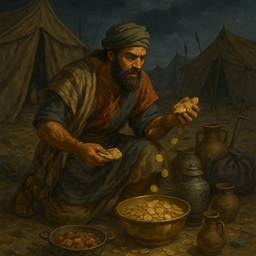
So we read in 2 Kings 7:8,
8 When these lepers came to the outskirts of the camp, they entered one tent and ate and drank, and carried from there silver and gold and clothes, and went and hid them, and they returned and entered another tent and carried them from there also and went and hid them.
Armies in those days carried supplies and personal effects with them, and if they lost the battle, the opposing side usually were able to plunder the camp and often gain much wealth. This is the picture that Zechariah painted for us in Zechariah 14:14. Today, of course, the fulfillment will be somewhat different, because the scope of the war is much greater. In general, we can say that the New Covenant overcomers, who are viewed as spiritual lepers and outcasts, will receive the wealth of nations.
Zechariah 14:15 says,
15 So also like this plague will be the plague on the horse, the mule, the camel, the donkey and all the cattle that will be in those camps.
This is the same “plague” as mentioned in Zechariah 14:12, describing what appears to be a nuclear radiation event. Perhaps these cattle will suffer from radiation poisoning along with their owners. Or it may be that these different animals represent other things. Zechariah does not offer any further explanation.
The prophet then skips to the ultimate result of the battle. Zechariah 14:16 says,
16 Then it will come about that any who are left of all the nations that went against Jerusalem will go up from year to year to worship the King, the Lord of hosts, and to celebrate the Feast of Booths [or Tabernacles].
No doubt we are to view this in conjunction with Isaiah 2:2-4, where we see people from all nations coming to the New Jerusalem to worship God and to learn His laws and His ways. It is understood, of course, that these people will also keep Passover and Pentecost in a New Covenant manner. They will be justified by faith (Passover), filled with the Spirit (Pentecost), and ultimately receive glorified bodies (Tabernacles).
To receive the glorified body, one must observe the first two feasts to qualify for the third. The command of God is that we stand before Him three times in the year. Exodus 34:23 says,
23 Three times a year all your males are to appear before the Lord God, the God of Israel.
Zechariah 14:17-19 continues,
17 And it will be that whichever of the families of the earth does not go up to [New] Jerusalem to worship the King, the Lord of hosts, there will be no rain on them. 18 If the family of Egypt [for example] does not go up to enter, then no rain will fall on them; it will be the plague with which the Lord smites the nations who do not go up to celebrate the Feast of Booths. 19 This will be the punishment of Egypt and the punishment of all the nations who do not go up to celebrate the Feast of Booths.
Rain is a well-known symbol of the outpouring of the Holy Spirit. Joel 2:23, for example, speaks of two rains—the former rain and the latter rain, each necessary for the earth to bring forth fruit that God desires (James 5:7). Those who fail to observe the feasts (in a New Covenant manner) will not experience the rain of the Holy Spirit. It seems also that Egypt was singled out, because it represents bondage and slavery, which also characterizes the Old Covenant. The purpose of the feasts is to give us liberty progressively in three steps through these feasts. Underlying all of this, of course, is that the Old Covenant cannot bring anyone to the Feast of Tabernacles and to the ultimate freedom and rejoicing promised in the law of Jubilee.
Zechariah 14:20 says,
20 In that day there will be inscribed on the bells of the horses, “Holy to the Lord.” And the cooking pots in the Lord’s house will be like the bowls before the altar.
These words, “Holy to the Lord” were inscribed on the high priest’s tiara (Exodus 39:30). Since Adam’s sin, God made a distinction between holy and profane until such time that all things will be “Holy to the Lord.” In the case above, this inscription will be “on the bells of the horses.” Horses represent war. In that day there will be no unrighteous wars—and, for nearly a thousand years, no war at all (Isaiah 2:4).
Likewise, instead of holiness being attributed to just “the bowls before the altar,” it will be ascribed to “the cooking pots” as well. In other words, holiness—being set apart for divine service—will begin to spread to all things, as more and more profane things will be dedicated to divine service. Even the law itself made provision for this through the law of devotion (or consecration). Leviticus 27:28 says,
28 Nevertheless, anything which a man sets apart to the Lord out of all that he has, of man or animal or of the fields of his own property, shall not be sold or redeemed. Anything devoted to destruction is most holy to the Lord.
Ultimately, at the restoration of all things, all things will be devoted and consecrated to Jesus Christ the King of Kings (1 Corinthians 15:27, 28). The creation will no longer be divided between holy and profane, for all things will be holy.
Zechariah 14:21 ends his prophecy,
21 Every cooking pot in Jerusalem and in Judah will be holy to the Lord of hosts, and all who sacrifice will come and take of them and boil in them. And there will no longer be a Canaanite in the house of the Lord of hosts in that day.
This does not mean all biological Canaanites will be killed or expelled, as it might have happened under the Old Covenant. It means that they will all be followers of Christ through the New Covenant and thereby enjoy equal status with Israelites, as prophesied in Isaiah 56:6-8).
The word Canaanite literally means “merchant, trafficker, lowlander.” So also, after Jesus turned water into wine at Cana, he cleansed the temple. John 2:16, 17 says,
16 and to those who were selling the doves, He said, “Take these things away; stop making My Father’s house a place of business.” 17 His disciples remembered that it was written [Psalm 69:9], “Zeal [kina in Hebrew] for Your house will consume me.”
Cana, Canaanite (merchants), and kina (“zeal”) all speak into this prophetic act of cleansing the temple. What Jesus did with a whip began a long process of temple cleansing that Zechariah prophesied in his closing remark.
Just as Jesus’ disciples “remembered” these things later, so also God will remember His New Covenant promise to restore all things. He will not cease His labor until all things are holy to the Lord, beginning with His house. Cleansing the temple was only the first step toward universal consecration to Him, where there is no longer any disagreement with His will and no longer any opposition to His right to rule all that He has created.
Zechariah, the Prophet of God’s remembrance, gives us a fitting climax that sets forth the results of His remembrance of His New Covenant promise.

Dr. Stephen Jones has been writing blog posts since 2005 on a variety of topics from Bible Studies to World News, and he has been writing books since 1992. Dr. Jones' most important writings came after God brought him back into the full-time ministry in 1991. It is here that all his earlier years of searching the Scriptures began to come into clear focus. He combines a knowledge of the Old and New Testaments with a personal revelation of God that began and developed during the "wilderness" period of his life, which he often refers to as God's True Bible College... Read More
We are only able to do what we do because of your support. If you feel led to support this ministry, we deeply appreciate it