Latest Posts
View the latest posts in an easy-to-read list format, with filtering options.

View the latest posts in an easy-to-read list format, with filtering options.
Multi-part posts on a particular topic, grouped together in "series" pages.
Look through our blog archive by year / month, or in a massive title list.

03/24/2026 - When President Trump backed down from bombing Iran’s nuclear power plant at Bushehr, under t... Read More
03/23/2026 - After asserting that all unbelievers will have to give account of their actions to the Judge at th... Read More

03/23/2026 - Today President Trump announced that the impending US attack on Iran’s power plants has been... Read More
Read over 100 books written by Dr. Jones, available to read for free online. Several of the books have also been translated into different languages, and are also available to read for free. The only time you pay is when you purchase a physical version of a book.
View Full Book List

Read a variety of tracts that condense a topic into a short, single page format. These tracts can be read for free online, or physical copies can be purchased in bundles. If you are subscribed to the FFI Newsletter, you will receive new tracts when they are released.
View Full Tract ListAchish, the Philistine king of Gath, sent David home to Ziklag before battling the Israelites, because his lords and commanders did not trust David’s loyalty. In doing so, they fulfilled the will of God, who did not want David to participate in Saul’s death or in the overthrow of his kingdom.
1 Samuel 30:1, 2 says,
1 Then it happened when David and his men came to Ziklag on the third day, that the Amalekites had made a raid on the Negev and on Ziklag and had overthrown Ziklag and burned it with fire; 2 and they took captive the women and all who were in it, both small and great, without killing anyone; and carried them off and went their way.
Recall that a year earlier, when David first moved to Ziklag, he mounted a raid against the Amalekites, whose territory was just south of Ziklag in the Negev (1 Samuel 27:8). This act had secured the trust of King Achish, because it extended the southern border of Philistia, thereby increasing the power of King Achish himself.
However, it seems that the Amalekites took advantage of the Philistine war against Israel. They figured that the Philistine army and David’s 600 men of war had marched far north, leaving all the Philistine towns and cities vulnerable to attack. They did not know that David would be sent back to Ziklag so soon.
Once again, this shows the providence of God and how He used the suspicious lords of the Philistines to help resolve this problem. David’s unexpected return worked in his favor, because the Amalekites were taken totally by surprise. David attacked them while they were feasting and rejoicing over their great victory.
David’s men were, however, exhausted from their long march south to Ziklag. Two hundred of them, in fact, had to rest about 15 miles short of Ziklag along the Brook Besor (1 Samuel 30:10).
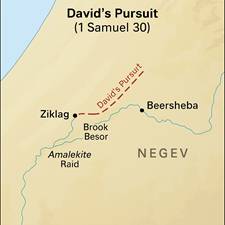
The 200 men rested and guarded most of their supplies while the other 400 continued their journey to Ziklag. There they discovered that their town had been burned to the ground. They also discovered an Egyptian who had been in the Amalekite army but who had become ill. He had been abandoned three days earlier, because the Amalekites assumed that he was dying.
David gave this Egyptian water and food, promising to protect him in exchange for information. The Egyptian agreed to lead David and his men to the Amalekite camp (1 Samuel 30:16) as long as he would not return him to his former master.
16 When he had brought him down [to the Amalekite camp], behold, they were spread over all the land, eating and drinking and dancing because of all the great spoil that they had taken from the land of the Philistines and from the land of Judah.
David destroyed all of them except for 400 who fled on camels. 1 Samuel 30:18, 19 concludes,
18 So David recovered all that the Amalekites had taken and rescued his two wives. 19 But nothing of theirs was missing, whether small or great, sons or daughters, spoil or anything that they had taken for themselves; David brought it all back [to Ziklag].
In addition, David captured the sheep and cattle which the Amalekites had brought with them to supply their army with food for the war campaign (1 Samuel 30:20).
David brought the spoils of war to the brook Besor, where the 200 soldiers were resting and guarding the baggage. A controversy then arose. 1 Samuel 30:22 says,
22 Then all the wicked and worthless men [literally, “wicked men of Belial”] among those who went with David said, “Because they did not go with us [to the battle], we will not give them any of the spoil that we have recovered, except to every man his wife and his children, that they may lead them away and depart.”
The term “men of Belial” was a Hebrew idiom for “good-for-nothing scoundrels.” We see the same kind of terminology used of the corrupt sons of Eli who “knew not the Lord” (1 Samuel 2:12 KJV). Not all of David’s men were righteous in the sight of God, because they did not know the mind of God. So Scripture gives them a bad report without naming them specifically.
Perhaps we might see these “men of Belial” as prophetic types of those who want to be overcomers but whose character fails to reflect the mind of Christ. They had faith in David even as many believers have faith in Christ, but the law of God has not been written in their hearts. They did not love their neighbor as themselves (Leviticus 19:18; Luke 10:27).
David, however, knew the mind of God and established a good precedent in 1 Samuel 30:23-25,
23 Then David said, “You must not do so, my brothers, with what the Lord has given us, who has kept us and delivered into our hand the band that came against us. 24 And who will listen to you in this matter? For as his share is who goes down to the battle, so shall his share be who stays by the baggage; they shall share alike.” 25 So it has been from that day forward, that he made it a statute and an ordinance for Israel to this day.
This ruling prevented division and dissention within the ranks of David’s army. It also reminds me of Jesus’ statement in Matthew 10:40-42,
40 “He who receives you receives Me and he who receives Me receives Him who sent Me. 41 He who receives a prophet in the name of a prophet shall receive a prophet’s reward; and he who receives a righteous man in the name of a righteous man shall receive a righteous man’s reward. 42 And whoever in the name of a disciple gives to one of these little ones even a cup of cold water to drink, truly I say to you, he shall not lose his reward.”
The principle behind Jesus’ statement is that we shall receive an equal reward of those that we assist or support. This is the “statute” that David established in Israel.
In 1 Samuel 30:26-31 we read how David also shared the spoils of war with 13 other cites in Israel, even though they had not participated in the battle against the Amalekites. No doubt this had the effect of reducing the divisions between David and the rest of Israel that had been brought about by Saul’s persecution. The precedent was based on love of one's neighbor, as set forth in the second great commandment. It also gave silent testimony that David had been fighting battles that Saul should have fought on behalf of Israel as a whole. By giving the Israelite cities a portion of the spoils of war, he implied that he had fought on behalf of Israel and for Israel's benefit.
David did not try to take vengeance on Saul’s family and Saul’s supporters. Instead, he won over most of them by his acts of kindness and forgiveness, for he knew the mind of Christ and the second great commandment to love your neighbor as yourself.

Dr. Stephen Jones has been writing blog posts since 2005 on a variety of topics from Bible Studies to World News, and he has been writing books since 1992. Dr. Jones' most important writings came after God brought him back into the full-time ministry in 1991. It is here that all his earlier years of searching the Scriptures began to come into clear focus. He combines a knowledge of the Old and New Testaments with a personal revelation of God that began and developed during the "wilderness" period of his life, which he often refers to as God's True Bible College... Read More
We are only able to do what we do because of your support. If you feel led to support this ministry, we deeply appreciate it