Latest Posts
View the latest posts in an easy-to-read list format, with filtering options.

View the latest posts in an easy-to-read list format, with filtering options.
Multi-part posts on a particular topic, grouped together in "series" pages.
Look through our blog archive by year / month, or in a massive title list.

03/31/2026 - We will leave here tomorrow morning to go to the weekend Passover conference in Chattanooga, TN, a... Read More

03/30/2026 - The latest biblical commentaries Ecclesiastes: The Philosophical Preacher, and Philippians, Philem... Read More

03/30/2026 - ... Read More
Read over 100 books written by Dr. Jones, available to read for free online. Several of the books have also been translated into different languages, and are also available to read for free. The only time you pay is when you purchase a physical version of a book.
View Full Book List

Read a variety of tracts that condense a topic into a short, single page format. These tracts can be read for free online, or physical copies can be purchased in bundles. If you are subscribed to the FFI Newsletter, you will receive new tracts when they are released.
View Full Tract ListNahum is said to be an Elkoshite, which means he was from a small, obscure town called Elkosh. Its location is disputed. Ancient rabbis claimed that it was located in Galilee. In the third century, Bishop Eusebius of Caesarea wrote that it was located in Galilee. In the fifth century, Jerome, the translator of the Bible into Latin, affirms this.
Nonetheless, because Nahum spoke comfort to Judah (Nahum 1:15), some believe that Elkosh was a town in Judah. There is also a tradition that Nahum was buried in Alqosh, which is near modern-day Mosul in Iraq. There is a tomb there identified as Nahum’s tomb, and the ruins of a shrine to him is still in existence. It does not seem likely that Nahum was born in Iraq, but because no one knows where Elkosh was actually located, some may believe that he was indeed born and later buried in Alqosh.
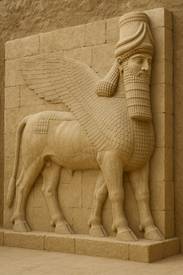
Mosul, of course, is next to the ruins of ancient Nineveh. Perhaps this tradition is supported by the nearby tomb of Jonah, as seen below. (ISIS destroyed the tomb in 2014.)
Nahum 1:3 says that “the Lord is slow to anger” but also that “the Lord will by no means leave the guilty unpunished.” We know this from many biblical examples, because God often waited decades and even centuries before bringing judgment upon the rebellious Israelites. God always gave them a grace period, sending prophets to urge repentance to avoid calamity.
Exodus 34:6, 7 says,
6 Then the Lord passed by in front of him [Moses] and proclaimed, “The Lord, the Lord God, compassionate and gracious, slow to anger and abounding in lovingkindness and truth, 7 who keeps lovingkindness for thousands, who forgives iniquity, transgression and sin; yet He will by no means leave the guilty unpunished, visiting the iniquity of fathers on the children and on the grandchildren to the third and fourth generations.”
This is repeated in Numbers 14:18. Nahum was familiar with the law of God, and he asserts this revelation of God’s mercy and justice at the beginning of his prophecy. He then gives various images and metaphors depicting the power of God—all of which must be viewed within the parameters of His mercy and justice.
Nahum 1:3-5 says,
3 … In whirlwind and storm is His way, and clouds are the dust beneath His feet. 4 He rebukes the sea and makes it dry; He dries up all the rivers. Bashan and Carmel wither. 5 Mountains quake because of Him and the hills dissolve; indeed the earth is upheaved by His presence, the world and all the inhabitants in it.
The prophet suggests that tornadoes, storms, and earthquakes are divine judgments and not merely “natural” phenomena. So also the great earthquake that destroyed Israel (Amos 1:1) and weakened it militarily allowed Nineveh/Assyria to conquer it later. The quake itself occurred as a precursor to the final judgment upon Israel at the hand of Nineveh. The prophet Amos had been sent from Judah as a missionary to Israel to issue a call to repentance, but his message had been rejected. After a grace period of two years, the earthquake struck.
Even then, Israel received more time to repent before the Assyrians conquered them. Unfortunately, the Israelites failed to see the earthquake as a sign of greater judgment yet to come. Their failure to repent brought disaster to the nation.
Nahum also reminds his readers that “He rebukes the sea and makes it dry,” probably a reference to the Red Sea parting which allowed the Israelites to escape Pharaoh’s army (Exodus 14:21, 22). Again, “He dries up all the rivers,” probably a reference to cutting off the waters of the Jordan River that allowed the Israelites to cross the river on dry ground (Joshua 3:17). These are two examples of the power of God to assist His people when they were in compliance with the terms of His covenant.
The prophet continues in Nahum 1:6,
6 Who can stand before His indignation? Who can endure the burning of His anger? His wrath is poured out like fire and the rocks are broken up by Him.
Pharaoh could not “stand before His indignation,” Bringing judgment upon Pharaoh also brought mercy to the Israelites. Neither could Pharaoh “endure the burning of His anger” (חֲרוֹן אַף, charon ’aph) — literally “burning of the nose,” an idiom for intense anger. No man can stand against the power of God and hope to win. Many try, thinking that God is wrong or unjust in His judgments, but their opinions are based on their unlawful views of morality along with the wisdom of men which God deems to be foolishness.
Numbers 1:7, 8 continues,
7 The Lord is good, a stronghold in the day of trouble, and He knows those who take refuge in Him. 8 But with an overwhelming flood He will make a complete end of its site and will pursue His enemies into darkness.
The goodness of God is revealed when Moses went up the Mount to intercede for the Israelites after they had worshiped the golden calf. Exodus 33:18, 19 says,
18 Then Moses said, “I pray You, show me Your glory!” 19 And He said, “ I Myself will make all My goodness pass before You, and will proclaim the name of the Lord before you; and I will be gracious to whom I will be gracious, and will show compassion on whom I will show compassion.”
Moses asked to see the “glory” of God, and God then showed him His “goodness.” His glory is manifested by His goodness. His goodness is the essence of His glory. No one can understand the glory of God without seeing His goodness. Many want to see God’s glory without understanding that the goodness of God leads us to repentance (Romans 2:4 KJV).
More than that, the calling of Abraham and His children is to bless all nations. How? It is “by turning every one of you from your wicked ways” (Acts 3:26). When the Abrahamic calling is fulfilled fully, the result will be “the restoration of all things” (Acts 3:21).
The goodness of God is set forth in the revelation of the divine plan to save the world and to bring all things under the feet of Christ, so that God may be “all in all” (1 Corinthians 15:27, 28). Yet not all are saved at the same time, because God uses the few to bring the word of reconciliation to the many. This means that God first trains the remnant of grace to share the work of Christ in the ages to come, so that the rest of humanity may learn His ways and be reconciled to Him. When the age of judgment ends with the Creation Jubilee, then all will know the goodness of God.
So 2 Corinthians 5:18, 19 says,
18 Now all these things are from God, who reconciled us to Himself through Christ and gave us the ministry of reconciliation, 19 namely, that God was in Christ reconciling the world to Himself, not counting their trespasses against them, and He has committed to us the word of reconciliation.
Let us, then, be a blessing to all nations as ambassadors for Christ, being sent to the world with the word of reconciliation. By this, we make known the goodness of God.

Dr. Stephen Jones has been writing blog posts since 2005 on a variety of topics from Bible Studies to World News, and he has been writing books since 1992. Dr. Jones' most important writings came after God brought him back into the full-time ministry in 1991. It is here that all his earlier years of searching the Scriptures began to come into clear focus. He combines a knowledge of the Old and New Testaments with a personal revelation of God that began and developed during the "wilderness" period of his life, which he often refers to as God's True Bible College... Read More
We are only able to do what we do because of your support. If you feel led to support this ministry, we deeply appreciate it