Latest Posts
View the latest posts in an easy-to-read list format, with filtering options.
View the latest posts in an easy-to-read list format, with filtering options.
Multi-part posts on a particular topic, grouped together in "series" pages.
Look through our blog archive by year / month, or in a massive title list.

03/31/2026 - We will leave here tomorrow morning to go to the weekend Passover conference in Chattanooga, TN, a... Read More

03/30/2026 - The latest biblical commentaries Ecclesiastes: The Philosophical Preacher, and Philippians, Philem... Read More

03/30/2026 - ... Read More
Read over 100 books written by Dr. Jones, available to read for free online. Several of the books have also been translated into different languages, and are also available to read for free. The only time you pay is when you purchase a physical version of a book.
View Full Book List
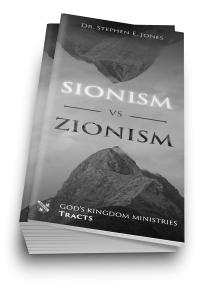
Read a variety of tracts that condense a topic into a short, single page format. These tracts can be read for free online, or physical copies can be purchased in bundles. If you are subscribed to the FFI Newsletter, you will receive new tracts when they are released.
View Full Tract ListGenesis 1:1 says,
1 In the beginning God (alef-tav) created the heavens and the earth.
The Hebrew text includes the two letters, alef and tav, in the text, but normally these remain untranslated. They are the first and last letters of the Hebrew alphabet, referencing Jesus Christ, who is (in Greek) “the alpha and omega, the first and the last, the beginning and the end” (Revelation 22:13).
Hence, Genesis 1:1 positions Christ not only as the Creator but also as the Mediator between heaven and earth. This was pictured again when He hung on the cross, suspended between heaven and earth.
The Kingdom of God includes a King, citizens, laws, and territory (land). Christ is the King, the lawful Heir of all things. As believers in Christ, we are the citizens of His Kingdom. We are thus subject to His laws, which were never repealed (Matthew 5:17; Romans 3:31). Our present focus, however, is on the territory of the Kingdom.
The territory (boundary) of the Kingdom of God is defined in Genesis 1:1. It is not merely in the heavens but also includes the earth as a whole. As the Creator, Christ has full labor rights. He owns all that He has created. The devil created nothing. The devil has merely usurped or misused that which Christ already created. So we read in Leviticus 25:23,
23 The land, moreover, shall not be sold permanently, for the land [eretz, “land” or “earth”] is Mine; for you are but aliens and sojourners with Me.
He was the Creator at the beginning. The earth was sold temporarily on account of sin, but in the end it will be restored to His rule (1 Corinthians 15:27, 28). This is called “the restoration of all things” (Acts 3:21).
This means that Christ is the great Landlord of the earth. Anyone who “owns” a piece of land is merely a steward who has an obligation to subject its use to the laws of God. God puts it this way: “you are but aliens and sojourners with me.”
When God chose Abraham to be His steward, He decided to start small. He gave Abraham the land of Canaan, a tiny strip of land which was a fractal of the earth itself. But when Abraham arrived in the Promised Land, he quickly discovered that it had been dedicated to Baal (and other equivalent gods), which the Canaanites worshiped. Baal literally means “lord,” as many have pointed out, but more specifically, it refers to a landowner, that is, a landlord.
Hence, the Canaanites backed a false god’s claim to the land. This false god claimed the firstborn sons from every family, mimicking the Creator’s claims in Numbers 3:13. While God took the firstborn to serve Him and the people, Baal, the usurper, took the firstborn to kill them. The priests of Baal (canna baal) ate their flesh and drank their blood (with its adrenochrome). This was an abomination to the Creator and a terrible misuse of Creation.
Eventually, David came to the throne in Israel. As a type of Christ in the Kingdom fractal, he established the main biblical pattern of the greater Kingdom yet to come. As a steward, David took the land from the dominion of Baal and placed it under the authority of Christ.
However, after David died, the Kingdom began to revert back to the dominion of false gods. Solomon started out as a wise king, but the last half of his reign was corrupted by other gods. For the next two centuries, ungodly kings refused to see themselves as stewards and instead treated the land as if they were its owners. God then expelled the Israelites from 745-721 B.C., sending them into exile in Assyria.
God had warned the Israelites—even before they arrived in Canaan—that He would expel them from the land if they acted like Canaanites (Leviticus 18:25-29). God is impartial in His judgments. So He judged the Israelites by the same law by which He had judged the Canaanites.
In 604-586 B.C. God brought judgment against Judah as well, sending them into the Babylonian captivity. Why? Because they had followed the laws of Baal and Molech by sacrificing their firstborn children in the valley of Ben-hinnom outside Jerusalem (Jeremiah 19:4-6). The horrors of human sacrifice were the direct cause of their expulsion from the land. Neither Judah or Israel had the right to dedicate their land to false gods who had usurped the Creator’s right to own that which He labored to create.
The captivities and expulsion showed the failure of the Old Covenant, which was based on the vows of men and the will of the flesh. God then sent His Son to mediate a New Covenant (1 Timothy 2:5), as had been prophesied earlier in Jeremiah 31:31. This did not happen overnight. It took six more centuries just to see the birth of Christ. And even then, the Kingdom did not emerge suddenly or fully. The King was here, but His right to rule was challenged by the religious establishment (Luke 19:14).
The Sanhedrin usurped the right of Jesus Christ to rule that land. It was done according to the pattern of Absalom, who usurped David’s throne with the help of Ahithophel (2 Samuel 15:30, 31). This set the New Testament pattern, where Caiaphas played the role of Absalom, Jesus played the role of David, who made a sacrifice on the Mount of Olives, and Ahithophel played the role of Judas.
By usurping the throne rights of Jesus Christ, Caiaphas, representing the Jewish leadership, became the classic antichrist system, just as Absalom had been an anti-David. The Greek term anti is translated “in place of” (Matthew 2:22). In its negative application, it means a usurper. Hence, in 2 Thessalonians 2:4, Paul cryptically referred to the high priest in Jerusalem as a usurper:
4 who opposes and exalts himself above every so-called god or object of worship, so that he takes his seat in the temple of God, displaying himself as being God.
God was in no hurry to resolve this dispute between Jews and Christians. It would take another 2,000 years for God to settle the dispute in the divine court. Jesus’ parable in Luke 19 suggests that the dispute would be resolved in conjunction with the return of Christ. Luke 19:27 says,
27 But these enemies of mine, who did not want me to reign over them, bring them here and slay them in my presence.
This foretells the rise of Zionism in the last days. Zionism is a political movement to return to the old land so that they may be judged for rejecting Christ as King. If the Zionists had returned as believers in Christ, the outcome might have been quite different. But they returned without repenting for usurping His right to rule that land—or any other portion of the earth. Hence, they failed to dedicate the land to the rightful Heir, the alef-tav.
Therefore, Christ’s prophecy will surely be fulfilled: “slay them in my presence.” Fortunately, not all Jews are Zionists. It is apparent that God has chosen a representative number of them to fulfill the divine judgment, while the majority will be spared.
Christian Zionists too will be judged for their support of the antichrists. Christian Zionists today represent Ahithophel and Judas. Ahithophel was David’s counselor and friend (Psalm 41:9; 55:12-14). Judas too was Jesus’ friend (Matthew 26:50). Jesus’ enemies usurped His throne, but His friend betrayed him. That pattern is happening once again in our day.
So the great question of our time is this: Who do you support in the great dispute as to whose right it is to rule the earth? When called upon to give testimony in the divine court, who do you advocate to rule the earth? Is it the stewards of the Kingdom, or is it the usurpers?
Time is running out. Choose wisely.

Dr. Stephen Jones has been writing blog posts since 2005 on a variety of topics from Bible Studies to World News, and he has been writing books since 1992. Dr. Jones' most important writings came after God brought him back into the full-time ministry in 1991. It is here that all his earlier years of searching the Scriptures began to come into clear focus. He combines a knowledge of the Old and New Testaments with a personal revelation of God that began and developed during the "wilderness" period of his life, which he often refers to as God's True Bible College... Read More
We are only able to do what we do because of your support. If you feel led to support this ministry, we deeply appreciate it