Latest Posts
View the latest posts in an easy-to-read list format, with filtering options.
View the latest posts in an easy-to-read list format, with filtering options.
Multi-part posts on a particular topic, grouped together in "series" pages.
Look through our blog archive by year / month, or in a massive title list.

03/28/2026 - This appears to be true. Iran is showing a video of the captured marines. Let’s see if this... Read More
03/28/2026 - ... Read More
03/28/2026 - 1 Peter 5:8, 9 says, 8 Be of sober spirit, be on the alert. Your adversary, the devil, prowls arou... Read More
Read over 100 books written by Dr. Jones, available to read for free online. Several of the books have also been translated into different languages, and are also available to read for free. The only time you pay is when you purchase a physical version of a book.
View Full Book List
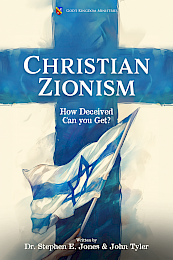
Read a variety of tracts that condense a topic into a short, single page format. These tracts can be read for free online, or physical copies can be purchased in bundles. If you are subscribed to the FFI Newsletter, you will receive new tracts when they are released.
View Full Tract List1 Peter 2:9 speaks not only of “a chosen race,” but also of “a royal priesthood.” This phrase comes directly from Exodus 19:6, where God told Israel: “You shall be to Me a kingdom of priests and a holy nation.”
Israel as a whole was called to be priestly, mediating God’s truth to the nations. Yet under the Old Covenant, the priesthood was limited to the tribe of Levi—and specifically to the sons of Aaron. The rest of the Levites were restricted from entering the sanctuary itself and were limited to doing the work in the outer court.
Peter now shows that through Christ this calling is given to the entire body of believers. “Royal priesthood” combines two roles: Royal (participation in the King’s authority) and Priesthood (access to God and the responsibility to represent Him). A change of priesthood was instituted through Christ, as we read in Hebrews 7:11, 12,
11 Now if perfection was through the Levitical priesthood (for on the basis of it the people received the Law), what further need was there for another priesthood to arise according to the order of Melchizedek, and not be designated according to the order of Aaron? 12 For when the priesthood is changed, of necessity there takes place a change of law also.
The order of Aaron (the Levitical priesthood) failed to live up to its responsibility in teaching the truth or in representing God to the people. They had a pattern of killing prophets culminating with the rejection and killing of the Son Himself. Jesus said as much in His parable of the vineyard in Matthew 21:34-38,
34 When the harvest time approached, he [the Owner—God] sent his slaves [prophets] to the vine-growers [or husbandmen] to receive his produce. 35 The vine-growers took his slaves and beat one, and killed another, and stoned a third. 36 Again he sent another group of slaves larger than the first; and they did the same thing to them. 37 But afterward he sent his son [Christ] to them, saying, “They will respect my son.” 38 But when the vine-growers saw the son, they said among themselves, “This is the heir; come, let us kill him and seize his inheritance.”
Jesus then asked them to judge the situation. Matthew 21:41 says,
41 They said to Him, “He will bring those wretches to a wretched end, and will rent out the vineyard to other vine-growers who will pay him the proceeds at the proper seasons.”
God did indeed replace them with another priesthood—the Melchizedek priesthood—as the book of Hebrews explains. This new priesthood was actually an older order of priests, dating back to Adam but which is mentioned explicitly for the first time in Genesis 14:18. Being associated with Abraham, it is the New Covenant priesthood, replacing the imperfect order of Aaron.
In fact, Jesus said that the stone of Daniel 2:35 was to grind that priesthood to powder. It would be difficult to maintain a priesthood that had been ground to powder and blown away by the wind. Nonetheless, in the past 150 years, with the rise of Christian Zionism, an attempt is being made to reinstate the Old Covenant priesthood. To such teachers, this seems necessary in order to be synergistic with a restored physical temple in the earthly Jerusalem and a resumption of animal sacrifices. Do they not know that we now have come into “better” things?
Matthew 21:45 concludes,
45 When the chief priests and the Pharisees heard His parables, they understood that He was speaking about them.
The idea of a royal priesthood appears again in Revelation 1:6, and 5:10, where believers are called “a kingdom and priests.” So, too, Peter calls these believers not only “a chosen race” but also “a royal priesthood,” even though it is doubtful that any of them, after seven centuries in exile, were able to trace their ancestry back to Aaron.
Peter continues by calling these believers-in-exile “a holy nation,” a designation given to Israel in Exodus 19:6. We know from history that this nation would become so unholy that it was necessary for the land to vomit out its inhabitants, as Moses had warned them in Leviticus 18:28. If their physical descent back to Abraham, Isaac, and Jacob could have made them holy, they might have remained in the land under the Old Covenant forever.
Paul explains this clearly when he asked if God had indeed cast out His people. Romans 11:1 says,
1 I say, then, God has not rejected His people, has He? May it never be!...
He goes on to explain that “His people” were the tiny remnant of grace—just 7,000 of them in the days of Elijah. This is also why the Israelites as a whole, after 40 years in the wilderness, still needed a second covenant to make them His people (Deuteronomy 29:1, 12, 13). Even 40 years of wilderness training had failed to make them God’s chosen people. It took a new covenant to accomplish this—a covenant of God’s oath (or vow), which was different from man’s vow to God in Exodus 19:8. The Deuteronomy covenant, like the Abrahamic covenant before it, set forth the New Covenant, which alone could be a success.
So Paul explains that God’s people were never rejected, even though the vast majority of the fleshly Israelites had indeed been cast off and exiled to Assyria. The remnant had been exiled from the land along with the rest of the people, but the true inheritance was not about having land in Canaan (Palestine). It was about being an heir of immortal life and the “land” inheritance of the glorified body that Adam had forfeited when he was exiled from Eden.
It was never about one’s genealogy, not even from the beginning. Adam had perfect genealogy when he sinned and lost his immortality. The requirement has always been faith, followed by obedience, followed by agreement. That is the three-step process of full salvation set forth in the prophetic feast days. Most of the Israelites failed in this, but there has always been a remnant of grace that God has reserved for Himself to carry the authority and responsibility of His calling.
That was Paul’s teaching in Romans 11:1-7, and Peter was in full agreement with him.
Peter compresses four covenant titles from Exodus and Isaiah into one sentence, which strongly suggests he saw those begotten by their heavenly Father as the restored priestly nation originally intended in Exodus 19.
1 Peter 2:10 says,
10 for you once were not a people, but now you are the people of God; you had not received mercy, but now you have received mercy.
Here the apostle quotes from Hosea 1:9, which was addressed to the faithless Israelites:
9 And the Lord said, “Name him Lo-ammi, for you are not My people and I am not your God.”
If being God’s people had been based on race, this statement would have been a lie. Many Christians ignore or deny this today, claiming that unbelieving Jews are God’s people based solely on their presumed descent from Abraham, Isaac, and Israel. But God does not lie. He disavows them and says, “I am NOT your God, even if you claim otherwise.”
Hosea was a prophet to the northern House of Israel, having married a harlot named Gomer (Hosea 1:3). The Assyrians called Israel “the house of Omri” on the Black Obelisk of Shalmanenzer, because King Omri of Israel was the first to set up diplomatic relations with Assyria. Omri was the father of King Ahab of Israel, who ruled from Samaria (1 Kings 16:23). At that time, Omri was written as Gomri. Hence, Hosea’s marriage to Gomer was a picture of God’s rocky marriage with the harlot, Israel. For more details, see my commentary on Hosea.
https://godskingdom.org/studies/books/hosea-prophet-of-mercy-book-1/
Hosea prophesied of the restoration of the northern ten tribes—the House of Israel. These are the so-called “lost tribes,” not the Jews (of the House of Judah). Hosea 2:23 prophesies,
23 … I will say to those who were not My people, “You are My people!” And they will say, “You are my God!”
Hence, the lost tribes of Israel were to be restored. They were cast off and declared “not My people” in 721 B.C., yet the day would come when God would reverse that decision, declaring, “You are My people!” While most Christians apply this prophecy to the Jews and the Zionist state which they have named Israel, it is a misapplication of prophecy. First of all, the biological Israelites of the northern kingdom are not today’s Jews; secondly, to be restored to God with the title Israel, one must be part of the remnant of grace. Why? Because this remnant, Paul says, carries the authority and responsibility of God’s people.
Hosea does not tell us the manner in which these ex-Israelites may become Israelites in the sight of God. Jeremiah speaks of a “new covenant” (Jeremiah 31:31), and Isaiah noted that “others” would be gathered to God with them (Isaiah 56:8). But the full revelation remained hidden until the Mediator of that Covenant came to earth. He taught the apostles the principles of Sonship, which Peter, John, and Paul all taught in their writings.
There is only one way back to a covenant relationship with God. It comes exclusively through the New Covenant. The Old Covenant was broken and thus became “obsolete” (Hebrews 8:13). No one can claim to be “God’s people” apart from faith in Jesus Christ. Yet that path is open to all men, regardless of their genealogy, “for whoever will call on the name of the Lord will be saved” (Romans 10:13).

Dr. Stephen Jones has been writing blog posts since 2005 on a variety of topics from Bible Studies to World News, and he has been writing books since 1992. Dr. Jones' most important writings came after God brought him back into the full-time ministry in 1991. It is here that all his earlier years of searching the Scriptures began to come into clear focus. He combines a knowledge of the Old and New Testaments with a personal revelation of God that began and developed during the "wilderness" period of his life, which he often refers to as God's True Bible College... Read More
We are only able to do what we do because of your support. If you feel led to support this ministry, we deeply appreciate it