Latest Posts
View the latest posts in an easy-to-read list format, with filtering options.
View the latest posts in an easy-to-read list format, with filtering options.
Multi-part posts on a particular topic, grouped together in "series" pages.
Look through our blog archive by year / month, or in a massive title list.
10/08/2026 - Ezekiel 1:1-3 begins, 1 Now it came about in the thirtieth year, on the fifth day of the fourth mo... Read More
10/07/2026 - Ezekiel is a book of judgment, restoration, and the glory of God. It explains why Jerusalem was be... Read More
10/06/2026 - Having exposed the political nature of the Little Horn’s religious beast empire, we can more... Read More
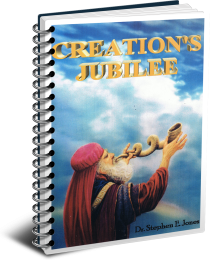
Read over 100 books written by Dr. Jones, available to read for free online. Several of the books have also been translated into different languages, and are also available to read for free. The only time you pay is when you purchase a physical version of a book.
View Full Book List

Read a variety of tracts that condense a topic into a short, single page format. These tracts can be read for free online, or physical copies can be purchased in bundles. If you are subscribed to the FFI Newsletter, you will receive new tracts when they are released.
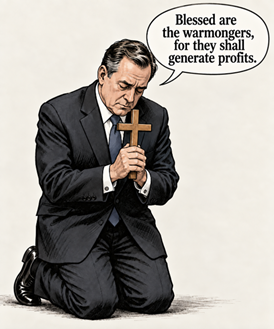
View Full Tract ListWhatever political view one has, we ought to subordinate it to the Scriptures and its moral system. When politicians or business leaders speak, we ought to discern whether they are motivated by the Scriptures or by their own version of morality. Their views are often based more on self interest than on building the Kingdom. A profitable view is attractive to them.
When Jesus said in Matthew 5:9, “Blessed are the peacemakers, for they shall be called Sons of God,” He spoke into an Old Covenant culture that yearned for the days of Joshua and the extermination of those perceived as “enemies.” Those enemies were not limited to the Romans; they also included the Samaritans and others.
Jesus, however, treated all those “enemies” with respect and love. This infuriated many of the religious leaders who were busy instilling hatred for others. They yearned for a messiah who would call down fire from heaven upon the Romans. They had a very Old Covenant view of the Kingdom and the manner in which it should come.
When the church redefined the New Covenant in terms of Old Covenant practice, it was not long before they were busy killing anyone who disagreed with their religious views. This later manifested in the Crusades, designed to take back the “Holy Land,” as if this real estate was promised to the church when it “replaced” Israel. They had almost totally forgotten that Abraham sought “a better country” (Hebrews 11:16) that was the true promise of God.
The result was an Old Covenant mindset that thinks that the Kingdom of God will be established by the will of man through force of arms. This mindset has brought us into deeper bondage.
The old land of Canaan/Israel/Palestine was the Old Covenant promise, but the Old Covenant was broken and made “obsolete” (Hebrews 8:13). The New Covenant promise actually goes back to Adam, who lost the glorified body, not to Moses and Joshua. The body was made of the dust of the ground and, as such, was regulated by the land laws of the Bible (Leviticus 25:23).
Adam’s sin incurred a debt that could not be paid or reconciled. He therefore lost the glorified body, pictured in Scripture as clothing, a tent, or a house (2 Corinthians 5:1-3). Our bodies were mortgaged. (Mort = dead, death; gage = pledge, security). This brought mortality, a state of death into our bodies, cutting us off from the life that God intended.
When Jesus died on the cross to pay the debt incurred by Adam’s sin, this mortgage was legally paid. According to the law of pledges, the pledge was to be returned to its original owner by the end of the day. Exodus 22:26 says,
26 If you ever take your neighbor’s cloak as a pledge, you are to return it to him before the sun sets.
Yet Paul tells us the obvious in 2 Corinthians 5:4 that God did not return our “cloak” to us immediately:
4 for indeed while we are in this tent, we groan, being burdened, because we do not want to be unclothed but to be clothed, so that what is mortal will be swallowed up by life.
While we were debtors to the law through sin, we actually owed God, because He was One that Adam offended. But when Christ paid the debt on the cross, that debt was canceled, and God was therefore responsible to return our immortal garments to us before sundown. Did He? No. We are still “the body of this death” (Romans 7:24). So did God violate His own law? No, but He does indeed owe us a glorified body. Yes, He is now indebted to us!
How do we know? Because Paul wrote in 2 Corinthians 5:5,
5 Now He who prepared us for this very purpose is God, who gave to us the Spirit as a pledge [arrabon].
Here Paul switched from Greek to Hebrew. Arrabon is a Hebrew word that is used in the story of Judah and Tamar in Genesis 38:18 and 20. A pledge is something a debtor gives as security on his debt. When the debt is paid, he gets back his arrabon.
We have received the Holy Spirit as a pledge (security) on God’s debt to believers whose sin-debt was paid at the cross. Hence, the glorified body, tent, or house has been reserved for us “in the heavens” (2 Corinthians 5:1). Legally, it belongs to us, but God has not returned it to us yet. That is why believers have remained mortal in spite of their faith.
More accurately, when we were begotten by the Spirit, a new entity was created within our spirit. Because it was begotten by immortal and incorruptible seed of the Word of God, that new entity is immortal and incorruptible (1 Peter 1:23-25). If we claim to be this new man, putting off the old man and his works, then we become new creatures in Christ. Even though we remain in mortal bodies, God has legally given us access to these new garments. Even so, we should consider our present condition to be a partial manifestation of what is yet to come. The manifestation, or unveiling, of the sons of God, which is “the redemption of our body” (Romans 8:23), is a future event that fulfills the feast of Tabernacles.

Dr. Stephen Jones has been writing blog posts since 2005 on a variety of topics from Bible Studies to World News, and he has been writing books since 1992. Dr. Jones' most important writings came after God brought him back into the full-time ministry in 1991. It is here that all his earlier years of searching the Scriptures began to come into clear focus. He combines a knowledge of the Old and New Testaments with a personal revelation of God that began and developed during the "wilderness" period of his life, which he often refers to as God's True Bible College... Read More
We are only able to do what we do because of your support. If you feel led to support this ministry, we deeply appreciate it