Latest Posts
View the latest posts in an easy-to-read list format, with filtering options.
View the latest posts in an easy-to-read list format, with filtering options.
Multi-part posts on a particular topic, grouped together in "series" pages.
Look through our blog archive by year / month, or in a massive title list.

10/21/2026 - I received this email from our ministry representative in Nepal today. Dear Respected Sir and pray... Read More
10/21/2026 - Ezekiel’s call as a watchman is described beginning in Ezekiel 3:18, 19, 18 When I say to th... Read More
10/20/2026 - Ezekiel 3:12-15 says, 12 Then the Spirit lifted me up, and I heard a great rumbling sound behind m... Read More
Read over 100 books written by Dr. Jones, available to read for free online. Several of the books have also been translated into different languages, and are also available to read for free. The only time you pay is when you purchase a physical version of a book.
View Full Book List
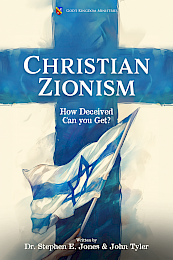
Read a variety of tracts that condense a topic into a short, single page format. These tracts can be read for free online, or physical copies can be purchased in bundles. If you are subscribed to the FFI Newsletter, you will receive new tracts when they are released.
View Full Tract ListThe roots of the present conflict between the Zionist nations and Iran trace back to the book of Genesis, especially in the story of Jacob and Esau.
Unfortunately, most people today, Christians and others, are unfamiliar with these roots. Christian Zionists themselves have failed to understand who is who in the world today, and they also fail to understand the mind of God because they do not know His law and how it prophesies of the current situation.
Those of you who have followed my weblogs for some years are knowledgeable and are capable of receiving deeper studies. But these weblogs must also accommodate new readers who are searching for the truth. So we must continue to go back to basics, without which it is not possible to understand today’s world or to catch a clear vision of God’s intention in establishing His Kingdom in the earth.
Abraham was a Hebrew (Genesis 14:13). Jacob was the first to receive the name Israel (Genesis 32:28). Judah was the first Jew, because Jew is just a shortened form of Judah. Hence, Abraham was not a Jew, nor was Jacob, nor were any of other tribes of Israel. Scripture never calls anyone a Jew who was not associated with the tribe or nation of Judah.
During the time of the United Kingdom under Saul, David, and Solomon, the name Israel applied to all of the tribes, because they were all citizens of the Kingdom of Israel. But after Solomon violated God’s covenant persistently, when he died, the kingdom was divided between 2 tribes and 10 tribes. 1 Kings 11:30-32 says,
30 Then Ahijah [the prophet] took hold of the new cloak which was on him and tore it into twelve pieces. 31 He said to Jeroboam, “Take for yourself ten pieces, for thus says the Lord, the God of Israel, ‘Behold, I will tear the kingdom out of the hand of Solomon and give you ten tribes 32 but he will have one tribe, for the sake of My servant David and for the sake of Jerusalem’…”
From then on, the prophets always made a clear distinction between Israel and Judah. It would have been confusing to call the southern kingdom Israel. When it spoke of Judah or the house of Judah, it referred to the southern kingdom that included Judah, Benjamin, and many Levites.
Judah, then, was no longer simply a tribal name but became a national identity that included Benjamin. Hence, the biblical definition of Judah was altered and expanded, while the definition of Israel explicitly excluded the people of Judah.
Both nations broke God’s covenant and both were held liable. Two centuries later, God said in Jeremiah 11:10,
10 … the house of Israel and the house of Judah have broken My covenant which I made with their fathers.
Israel sinned openly, while Judah sinned covertly, pretending to remain religious. God’s verdict was to divorce the House of Israel, sending them out of the house (to Assyria). Judah was spared for the moment, but yet God considered Judah to be worse than Israel. Jeremiah 3:8, 11 says,
8 And I saw that for all the adulteries of faithless Israel, I had sent her away and given her a writ of divorce, yet her treacherous sister Judah did not fear; but she went and was a harlot also… 11 And the Lord said to me, “Faithless Israel has proven herself more righteous than treacherous Judah.”
Israel was “faithless,” but Judah was “treacherous.” Both ended up in captivity, Israel to Assyria and Judah to Babylon. However, although Israel was divorced from God, there is no biblical statement that Judah was given a writ of divorce. Why? Because Jesus was yet to be brought forth from Judah—specifically from the House of David—and God could not do so if He had previously divorced Judah. It was a bad marriage, but the marriage itself was still valid—at least until after Judah had fulfilled its calling (Genesis 49:10).
The first covenant was violated by both Israel and Judah, and so it became “obsolete” (Hebrews 8:13). There was, therefore, a need for a different covenant. Jeremiah 31:31 prophesied of this:
31 “Behold, days are coming,” declares the Lord, “when I will make a new covenant with the house of Israel and with the house of Judah.”
The prophet retains the distinction between the two nations—Israel and Judah—but he implies a reunification in the future. This is stated more explicitly in Jeremiah 3:18,
18 In those days the house of Judah will walk with the house of Israel, and they will come together [yahad, “in union”] from the land of the north to the land that I gave your fathers as an inheritance.
Note that this union was to take place in the future. The New Covenant was another marriage covenant, but unlike the previous covenant that had been based on man’s will. This was based on the promise of God, not the promise of men. The main point is that this New Covenant is the basis of future unity. No one can claim to fulfill this promise apart from faith in the Mediator of that New Covenant. Such faith is what they must all have in common. As long as anyone continues to cling to the Old Covenant, he cannot fulfill this prophecy.
Isaiah defines the “return” not in terms of a physical return to the old land but as a return to God—repentance. Isaiah 31:6,
6 Return to Him from whom you have deeply defected, O sons of Israel!
Isaiah 55:6, 7 says,
6 Seek the Lord while He may be found; call upon Him while He is near. 7 Let the wicked forsake his way and the unrighteous man his thoughts; and let him return to the Lord, and He will have compassion on him, and to our God, for He will abundantly pardon.
Nonetheless, only a remnant was to “return.” Isaiah 10:21, 22 says,
21 A remnant will return, the remnant of Jacob, to the mighty God. 22 For though your people, O Israel, may be like the sand of the sea, only a remnant within them will return…
The Apostle Paul thus tells us in Romans 11:5, 7,
5 In the same way, then, there has also come to be at the present time a remnant according to God’s gracious choice… 7 What then? What Israel is seeking, it has not obtained, but those who were chosen obtained it, and the rest were hardened.
The “remnant” in Paul’s day were the believers in Jesus Christ. These had “returned” in the way that God required. It was not about changing one’s street address; it was about repentance and faith in Jesus Christ. Further, this remnant included people from other ethnicities and nations, as prophesied in Isaiah 56:7, 8. God’s intent was to build a spiritual temple that would be “a house of prayer for all the peoples.” God declared that “others I will gather to them, to those already gathered.”
If anyone doubts this, believing that the New Covenant is for biological Israelites and Judahites alone, let him read Jesus’ parable of the wedding feast in Matthew 22:1-10. The king invited the local people (Jews, in this case), but they refused to come. So in verses 8 and 9 we read,
8 Then he said to his slaves, “The wedding is ready, but those who were invited were not worthy. 9 Go therefore to the main highways, and as many as you find there, invite to the wedding feast.”
To fulfill this prophecy, do those people have to immigrate to the old land in order to attend the wedding feast for the King’s Son? Of course not. All that is required in the parable is a proper wedding garment—"the garments of salvation” (Isaiah 61:10). Further, Revelation 19:7-9 says,
7 “Let us rejoice and be glad and give the glory to Him, for the marriage of the Lamb has come and His bride has made herself ready.” 8 It was given to her to clothe herself in fine linen, bright and clean; for the fine linen is the righteous acts of the saints. 9 Then he said to me, “Write, ‘Blessed are those who are invited to the marriage supper of the Lamb’.” And he said to me, “These are the true words of God.”
This is again illustrated and prophesied by Jesus’ transfiguration on the Mount, where “His garments became as white as light” (Matthew 17:2). It was the place where Jesus was declared to be “My beloved Son” (Matthew 17:5). Jesus had gone up the mountain from Caesarea Philippi in the far north, up Mount Hermon, which was also called Mount Sion (Deuteronomy 4:48).
This, says Hebrews 12:22 KJV, is the place where the remnant of saints gather around Christ. It represents the New Jerusalem, the heavenly city, and it is NOT the seat of authority for the earthly Jerusalem, known as Mount Zion. Hence, we are Sionists, not Zionists. The seat of New Covenant government is a greater mountain representing a greater city.
Those who are invited to the wedding feast must be dressed in the garments of salvation, having been transfigured with Christ. This has nothing to do with their home address or the nation where they live. It is all about their relationship with Jesus Christ.

Dr. Stephen Jones has been writing blog posts since 2005 on a variety of topics from Bible Studies to World News, and he has been writing books since 1992. Dr. Jones' most important writings came after God brought him back into the full-time ministry in 1991. It is here that all his earlier years of searching the Scriptures began to come into clear focus. He combines a knowledge of the Old and New Testaments with a personal revelation of God that began and developed during the "wilderness" period of his life, which he often refers to as God's True Bible College... Read More
We are only able to do what we do because of your support. If you feel led to support this ministry, we deeply appreciate it