Latest Posts
View the latest posts in an easy-to-read list format, with filtering options.

View the latest posts in an easy-to-read list format, with filtering options.
Multi-part posts on a particular topic, grouped together in "series" pages.
Look through our blog archive by year / month, or in a massive title list.

10/21/2026 - I received this email from our ministry representative in Nepal today. Dear Respected Sir and pray... Read More

10/21/2026 - Ezekiel’s call as a watchman is described beginning in Ezekiel 3:18, 19, 18 When I say to th... Read More
10/20/2026 - Ezekiel 3:12-15 says, 12 Then the Spirit lifted me up, and I heard a great rumbling sound behind m... Read More
Read over 100 books written by Dr. Jones, available to read for free online. Several of the books have also been translated into different languages, and are also available to read for free. The only time you pay is when you purchase a physical version of a book.
View Full Book List



Read a variety of tracts that condense a topic into a short, single page format. These tracts can be read for free online, or physical copies can be purchased in bundles. If you are subscribed to the FFI Newsletter, you will receive new tracts when they are released.
View Full Tract ListWhen a nation splits into two groups, each competing for legitimacy, the inevitable question arises: Which group legitimately represents the nation itself? Which group has the legitimate right to claim the name of the nation?
In the case of the civil war wherein Absalom usurped David’s throne for a season, there were two groups of Judahites who claimed to be Judah. One was led by Absalom, the other by David. If left to the decisions of men, this right would be given to the majority. If left to the decision of God, this right would be given to the one that carried the anointing and its promise.
David’s group was tiny in comparison to Absalom’s group. Many (600) of David’s group were Gittites, that is, Philistines from Gath (2 Samuel 15:18). David’s group numbered in the thousands in total (2 Samuel 18:1), but his group were clearly a minority. By men’s democratic standards, Absalom was the true king of Judah. But God did not establish democracy, nor did He ever legitimize the decisions of the majority. God’s order was a monarchy.
Therefore, when David left Jerusalem, the anointing went with him. David remained the legitimate king, regardless of the opinions of men and regardless of Absalom’s claim. Even so, there was a real legal dispute that only God could resolve in the divine court. We are not told how long David remained in exile, probably because the story was prophetic of the dispute in the New Testament. Caiaphas and his supporters usurped the throne of Jesus Christ, bringing about the dispute over the throne of David and the dispute over the right to claim the name Judah.
When Paul defined who is and who is not a Jew (Judahite) in Romans 2:28, 29, he addressed this very dispute. Were the supporters of Jesus the legitimate Jews or were the supporters of Caiaphas the legitimate Jews? Paul says that legitimacy is set forth by the group that truly praises God. Judah means praise. So who actually lives up to the prophecy in the name Judah? Is it those with physical circumcision or those with heart circumcision? Is it those whom men assume are Jews or those whom God recognizes as Jews? You know Paul’s answer.
When David left Jerusalem, He set the prophetic pattern of Christ’s crucifixion on the Mount of Olives and then His ascension to heaven, awaiting the final decision in the divine court that alone could resolve the dispute. Hence, when David returned to Jerusalem, his return prophesied of the return of Christ to reclaim His throne.
When David returned, Absalom was killed (2 Samuel 18:14). This set the prophetic pattern for Christ’s return as well. The followers of Caiaphas—those who believe that his ruling against Jesus was legitimate according to the will of God—will find themselves to be overruled by the divine court. Absalom did not repent, nor was he made the chief administrator in David’s cabinet to rule the kingdom. Neither will those that men call Jews be placed in positions of power when Jesus returns.
In Luke 19:12-27, we read a parable that gives a basic outline of this prophetic dispute over the crown. It begins in Luke 19:12,
12 So He said, “A nobleman went to a distant country to receive a kingdom for himself, and then return.”
Everyone knows that this refers to Christ ascending to heaven until the dispute over the kingdom is resolved in the divine court—“and then return.” Luke 19:14 adds,
14 But his citizens hated him and sent a delegation after him, saying, “We do not want this man to reign over us.”
Caiaphas could not send a literal delegation to heaven in the same sense that Jesus ascended to heaven. However, the parable suggests that Caiaphas and the Sanhedrin appealed to God in the divine court to anoint someone else as their king. They found Jesus to be unacceptable.
Most of the parable has to do with the rewards given to the nobleman’s followers after his return, but it ends with the verdict against “his citizens” in Luke 19:27,
27 But these enemies of mine, who did not want me to reign over them, bring them here [to the old land] and slay them in my presence.
The stark reality is that the Zionists today are about to fulfill this prophecy. God has decreed that a representative number of Christ’s “enemies” must return to the original scene of the crime, not to receive the kingdom or even to accept Christ as king, but to be killed. The ending to this parable is consistent with the account of the death of Absalom at the return of David.
It is most unfortunate that Christian Zionists do not understand this parable, nor do they connect the story of Absalom to its fulfillment in the New Testament story. This misunderstanding causes them to encourage unbelieving Jewish Zionists to immigrate to the old land where the nation itself will be killed and many individuals will die as well. Some churches have even raised money to pay their expenses to relocate into the danger zone.
I abhor their actions, of course, and urge Israelis to leave as quickly as possible before this disaster occurs. Israelis need to be warned, but very few know the Scriptures well enough to warn them. The third “ruin” in Ezekiel 21:27 is coming shortly. The old earthen jar, broken irreparably in Jeremiah 19:10, 11, is about to be fulfilled.
Again, God’s judgment upon “Ariel” (Jerusalem) is about to be fulfilled (Isaiah 29:1-4), and the city is soon to become God’s hearth. Ariel has a double meaning: Lion of God and God’s Hearth. The city was supposed to be ruled by the Lion of the tribe of Judah (Revelation 5:5), but the “citizens” rejected Him. Therefore, God is turning the city into a fireplace, a hearth, as Isaiah prophesies.
Yet the warnings are so few that most people ignore them.
The resolution of the dispute over Christ’s throne rights has already been formally decreed in the divine court. God has raised up “the kings from the east” (Revelation 16:12) to carry out the judgment. In other words, the sixth bowl of wine has been poured out just before the final bowl destroys modern Babylon (Revelation 16:17-21).
The present pattern of judgment upon Babylon is based on the original conquest of Babylon at the hand of the Medes and Persians (Daniel 5:28-31). Darius the Mede and Cyrus the Persian were these original “kings.” Cyrus, the “messiah” (Isaiah 45:1) had already absorbed Elam just north of the Persian Gulf and had established his administrative capital in Susa (or Shushan).
Hence, the prophecy in Jeremiah 49:38 was fulfilled, “Then I will set My throne in Elam.” So we find Daniel living in Shushan after the fall of Babylon (Daniel 8:2). Likewise, Nehemiah served the king of Persia in Shushan (Nehemiah 1:1). Esther was queen in Shushan as well (Esther 1:2). Hence, “My throne” refers prophetically to the throne of Cyrus, the “messiah,” in the time of the Persian empire. Modern Persia is now known as Iran. Iran has inherited this calling today.
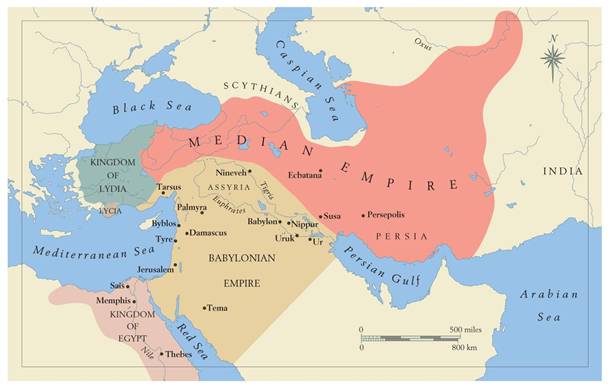
In Revelation 16:12 John tells us that the ancient pattern was to be repeated in the future at the time of the fall of Mystery Babylon, the spiritual city secretly ruling over the whole earth. God would again raise up an unspecified number of “kings from the east.” (This may also include Turkey, as the map shows.) Many prophecy teachers claim that these kings are God’s enemies, when in fact they are the ones God has raised up to set the world free from the slavery of Mystery Babylon.
Iraq includes the former territory of ancient Babylon along the River Euphrates. Ironically, when President Bush and his coalition overthrew Iraq in 2003, he set the prophetic pattern of the soon-coming overthrow of Mystery Babylon. Iraq had been the main counterforce to Iran. So when Iraq was destroyed, Iran was empowered. We now see the result today. One might conclude that President Bush dried up the River Euphrates to prepare the way for the kings from the east (Revelation 16:12). The Euphrates flowed through Babylon, and Cyrus literally dried up the river so that his troops could enter the city on dry ground and conquer Babylon.
Mystery Babylon is no longer the original city any more than the heavenly Jerusalem is the original Jerusalem. Mystery Babylon is much more extensive today, having three main capitals (or city states). The Vatican is the spiritual capital; the City of London is the financial capital; Washington D.C. is the military capital.
In recent years, Jerusalem has merged politically and militarily with Washington. Hence, the kings from the east today fight the main coalition of Washington and Jerusalem. When this military alliance collapses as a result of the seventh bowl of wine, Mystery Babylon will be left militarily powerless, and the true Messiah will set the earth free.
In my view, the (military) collapse of Mystery Babylon will coincide with the destruction of the Israeli state, as prophesied in Scripture.

Dr. Stephen Jones has been writing blog posts since 2005 on a variety of topics from Bible Studies to World News, and he has been writing books since 1992. Dr. Jones' most important writings came after God brought him back into the full-time ministry in 1991. It is here that all his earlier years of searching the Scriptures began to come into clear focus. He combines a knowledge of the Old and New Testaments with a personal revelation of God that began and developed during the "wilderness" period of his life, which he often refers to as God's True Bible College... Read More
We are only able to do what we do because of your support. If you feel led to support this ministry, we deeply appreciate it