Latest Posts
View the latest posts in an easy-to-read list format, with filtering options.

View the latest posts in an easy-to-read list format, with filtering options.
Multi-part posts on a particular topic, grouped together in "series" pages.
Look through our blog archive by year / month, or in a massive title list.
11/25/2026 - Ezekiel 12:11-13 provides the interpretation of this sign, 11 “Say, ‘I am a sign to yo... Read More
11/24/2026 - Ezekiel 12:1–7 begins with a diagnosis of spiritual blindness and ends with a sign the peopl... Read More
11/23/2026 - After explaining thoroughly the reasons why the presence of God was leaving Jerusalem and the grea... Read More
Read over 100 books written by Dr. Jones, available to read for free online. Several of the books have also been translated into different languages, and are also available to read for free. The only time you pay is when you purchase a physical version of a book.
View Full Book List
Read a variety of tracts that condense a topic into a short, single page format. These tracts can be read for free online, or physical copies can be purchased in bundles. If you are subscribed to the FFI Newsletter, you will receive new tracts when they are released.
View Full Tract ListEzekiel 12:11-13 provides the interpretation of this sign,
11 “Say, ‘I am a sign to you. As I have done, so it will be done to them; they will go into exile, into captivity.’ 12 The prince who is among them will load his baggage on his shoulder in the dark and go out. They will dig a hole through the wall to bring it out. He will cover his face so that he can not see the land with his eyes. 13 I will also spread My net over him, and he will be caught in My snare. And I will bring him to Babylon in the land of the Chaldeans; yet he will not see it, though he will die there.”
Here God explains the sign in two stages. Verse 11 applies it to the people still in Jerusalem. Verse 12 focuses on Zedekiah and shows how the city’s ruler would try to escape. The pronouns distinguish the two groups. “You” are the exiles in Babylonia who watched Ezekiel pack and leave. “Them” are the people still in Jerusalem, who would themselves go into captivity.
Note that God Himself takes credit for bringing the prince to Babylon. Nebuchadnezzar was only acting as God’s agent. God had called Nebuchadnezzar “My servant” (Jer. 27:6).
Each detail of the sign now points to the prince. He shoulders what he can carry, goes out in the dark, masking his face. Jeremiah 39:4-7 describes the historical flight.
4 When Zedekiah the king of Judah and all the men of war saw them, they fled and went out of the city at night by way of the king’s garden through the gate between the two walls; and he went out toward the Arabah. 5 But the army of the Chaldeans pursued them and overtook Zedekiah in the plains of Jericho; and they seized him and brought him up to Nebuchadnezzar king of Babylon at Riblah in the land of Hamath, and he passed sentence on him. 6 Then the king of Babylon slew the sons of Zedekiah before his eyes at Riblah; the king of Babylon also slew all the nobles of Judah. 7 He blinded Zedekiah’s eyes and bound him in fetters of bronze to bring him to Babylon.
Zedekiah and his soldiers slipped out at night through the king’s garden and the gate between the two walls. Ezekiel’s opening through the wall dramatizes the hurried escape. Jeremiah supplies the actual route.
The covered face has a particularly ominous meaning. Verse 12 says that the prince covers his face “so that he cannot see the land with his eyes.” In the sign, the covering prevents sight. In the fulfillment, the Babylonians catch Zedekiah, put out his eyes, and take him to Babylon (Jer. 52:8–11). Verse 13 makes the irony explicit. God would bring him to Babylon, yet he would never see it. He would remain blind during his entire life in captivity.
The chapter began with a people who had eyes but did not see (12:2). Now their ruler goes out with his eyes covered, foreshadowing the loss of his sight. The sign also suggests that a significant part of divine judgment is spiritual blindness, the inability to understand and respond to the word of God. Blindness was a major theme in the book of Isaiah.
In the law of tribulation, God foretold this blindness. Deuteronomy 28:28, 29 says,
28 The Lord will smite you with madness and with blindness and with bewilderment of heart; 29 and you will grope at noon, as the blind man gropes in darkness, and you will not prosper in your ways…
An English proverb says, “There are none so blind as those who will not see.” Scripture attributes such blindness to a rebellious heart that refuses to hear the word of God. Any time a person rejects the word, he thereafter assumes he is right, and if he never revisits his original error and repents, he remains blinded by his own assumptions.
Ezekiel 12:14 says,
14 “I will scatter to every wind all who are around him, his helpers and all his troops, and I will draw out a sword after them.”
Here the judgment moves from Zedekiah to the men around him. God says He will scatter “to every wind” all who support the king, including his helpers and troops, and will “draw out a sword after them.” Leviticus 26:33 says,
33 You, however, I will scatter among the nations and will draw out a sword after you, as your land becomes desolate [depopulated] and your cities become waste.
Ezekiel had already used that language in Ezekiel 5:2, 12, where he scattered part of his shaved hair to the wind and pictured the sword pursuing those it represented. In 12:14 the warning falls specifically on the men who had gathered around Zedekiah. Here the prophet enlarges the warning in Leviticus 26:33 to include those who assist and support the rulers of the sinful nation.
Jeremiah advised the king and the people in Jerusalem to submit to Nebuchadnezzar, because God had already decreed that the city would fall. Jeremiah 27:12 pleads, “bring your necks under the yoke of the king of Babylon and serve him and his people, and live.”
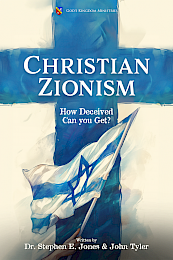
We see the same situation today. Zionism is an attempt to end the Jewish dispersion (captivity) without first repenting of the cause for judgment. The law itself allows a return only when the people as a whole repent (Leviticus 26:40-42). “If they confess their iniquity and the iniquity of their forefathers… and also in their acting with hostility against Me… then I will remember My covenant…”
This precondition was commonly understood 150 years ago, but Christian Zionism decided to support Jewish Zionism in their continued rebellion against God. Christian Zionists are those “helpers” who support the modern successors of Zedekiah. Ezekiel tells us that they too will be held accountable on some level when Jerusalem is finally destroyed for the last time (Jeremiah 19:10, 11; Isaiah 29:1-6).
Isaiah goes on to tell us that because the people had rejected the warning about Jerusalem’s destruction, He was going to blind the prophets themselves. Isaiah 29:10 says,
10 For the Lord has poured over you a spirit of deep sleep. He has shut your eyes, the prophets; and He has covered your heads, the seers.
The prophet goes on to say that literate men could not read the words of this vision because it was “sealed,” and illiterate men could not read it at all. Hence, even today it is common for prophets—even genuinely gifted prophets—to misunderstand or ignore Isaiah’s vision of the nuclear destruction of “Ariel” (Jerusalem). God has done this so that only the remnant of grace would see the truth, while “the rest were blinded” (Romans 11:7 KJV).
Ezekiel 12:15, 16 says,
15 “So they will know that I am the Lord, when I scatter them among the countries. 16 But I will spare a few of them from the sword, the famine and the pestilence that they may tell all their abominations among the nations where they go, and may know that I am the Lord.”
Those spared, no doubt, are Paul’s remnant of grace—those who are truly God’s chosen ones who carry the promise of God. Paul makes it clear in Romans 11:7 that biological Israelites are not chosen; only the remnant of grace is chosen, and this is on account of their faith.
In his prophecy of hair, Ezekiel also speaks of the chosen remnant. Ezekiel 5:3 says,
3 Take also a few [hairs] in number from them and bind them in the edges of your robes.
Paul expounds upon these chosen ones in Romans 8:29, 30,
29 For those whom He foreknew, He also predestined to become conformed to the image of His Son, so that He would be the firstborn among many brethren; 30 and these whom He predestined, He also called, and these whom He called, He also justified; and these whom He justified, He also glorified.
So if we are aware of the divine plan and believe His word, it is evidence that God has chosen us and has opened our eyes, so that we may avoid liability in the final judgment upon Jerusalem that is soon coming.

Dr. Stephen Jones has been writing blog posts since 2005 on a variety of topics from Bible Studies to World News, and he has been writing books since 1992. Dr. Jones' most important writings came after God brought him back into the full-time ministry in 1991. It is here that all his earlier years of searching the Scriptures began to come into clear focus. He combines a knowledge of the Old and New Testaments with a personal revelation of God that began and developed during the "wilderness" period of his life, which he often refers to as God's True Bible College... Read More
We are only able to do what we do because of your support. If you feel led to support this ministry, we deeply appreciate it