Latest Posts
View the latest posts in an easy-to-read list format, with filtering options.

View the latest posts in an easy-to-read list format, with filtering options.
Multi-part posts on a particular topic, grouped together in "series" pages.
Look through our blog archive by year / month, or in a massive title list.
10/09/2026 - Israel encampment in the wilderness mirrored Ezekiel’s vision of the four living creatures.... Read More
10/08/2026 - Ezekiel 1:1-3 begins, 1 Now it came about in the thirtieth year, on the fifth day of the fourth mo... Read More
10/07/2026 - Ezekiel is a book of judgment, restoration, and the glory of God. It explains why Jerusalem was be... Read More
Read over 100 books written by Dr. Jones, available to read for free online. Several of the books have also been translated into different languages, and are also available to read for free. The only time you pay is when you purchase a physical version of a book.
View Full Book List
Read a variety of tracts that condense a topic into a short, single page format. These tracts can be read for free online, or physical copies can be purchased in bundles. If you are subscribed to the FFI Newsletter, you will receive new tracts when they are released.
View Full Tract ListAfter Jacob deceived his father into giving him the blessing instead of Esau, Genesis 27:41 says,
41 So Esau bore a grudge against Jacob because of the blessing with which his father had blessed him; and Esau said to himself, “The days of mourning for my father are near; then I will kill my brother Jacob.”
Esau certainly had a lawful reason to resent his brother who had denied him his rights. Isaac himself had prophesied in the previous verse that Jacob would have to return the birthright to Esau at some point in the future in order to restore Esau’s right as the firstborn. Nonetheless, Esau should have been content with that knowledge, focusing on cleaning up his own character so as to prove himself worthy of this divine responsibility.
Jacob then fled to Haran, where he worked for his uncle Laban for 20 years. When he finally returned, Esau met him along the way with 400 men, intending to kill Jacob and steal all that he had (Genesis 32:6). That is when Jacob divided up his camp and then wrestled with the angel all night (Genesis 32:24).
The next day, when Jacob met Esau, it seemed that Esau had had a change of heart. Genesis 33:4 says,
4 Then Esau ran to meet him and embraced him, and fell on his neck and kissed him, and they wept.
Scripture has no explanation for this sudden turnaround. The ancient book of Jasher, chapter 32, however, tells us that God sent three angels to manifest four armed divisions of 500 men each, totaling 2,000 warriors, who met Esau and his 400 men. Esau told them that they were the servants of Jacob. Esau continued on his journey, only to be met by another 500 warriors. This happened four times in all.
By that time, Esau loved his brother dearly, so to speak.
This appears to be the only time in history that Esau or his descendants showed love for his brother. If Jasher’s account is accurate, Esau’s love was motivated by fear, and we know from 1 John 4:18 that “there is no fear in love… the one who fears is not perfected in love.” The apostle also cites the example of Cain and Abel, saying in 1 John 3:15,
15 Everyone who hates his brother is a murderer; and you know that no murderer has eternal life abiding in him.
What he wrote about Cain also applies to Esau. Of course, repentance would have changed their lawful status before God, but neither of them followed that course of action. Esau’s perpetual hatred is recorded in Ezekiel 35:5-7,
5 “Because you have had everlasting enmity and have delivered the sons of Israel to the power of the sword at the time of their calamity, at the time of the punishment of the end, 6 therefore as I live,” declares the Lord God, “I will give you over to bloodshed, and bloodshed will pursue you; since you have not hated bloodshed, therefore bloodshed will pursue you. 7 I will make Mount Seir a waste and a desolation…”
Scripture does not condemn Edom (Mount Seir) for desiring justice in the matter of the stolen birthright. Instead, it condemns Edom for failing to love his brother. Love is always the key. Those who love are those who know God (1 John 4:8). Furthermore, we read in 1 John 4:20,
20 If someone says, “I love God,” and hates his brother, he is a liar; for the one who does not love his brother whom he has seen, cannot love God whom he has not seen.
In the end, the true inheritors of the birthright are those who are motivated by love, because the entire divine law hangs on two principles: Love for God, and love for one’s neighbor. Those who lack the love that God requires will be disinherited, even if they are the biological firstborn sons.
When the time came for Israel to enter the Promised Land, after 40 years of wandering in the desert, God directed them to cross the Jordan River on the east side of Canaan. But to get there required passage through the land of Edom.
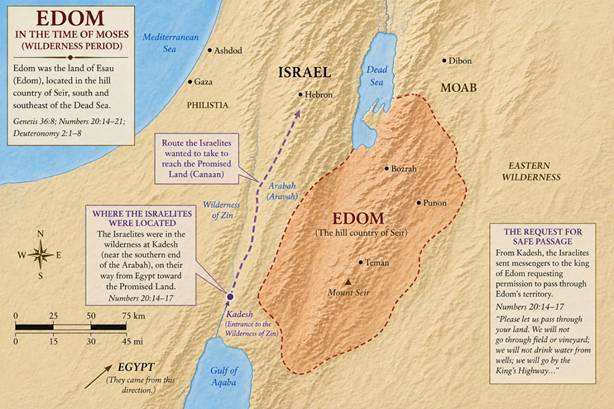
Numbers 20:14, 17, 18, and 21 says,
14 From Kadesh Moses then sent messengers to the king of Edom: “Thus your brother Israel has said, ‘You know all the hardship that has befallen us… 17 Please let us pass through your land…” 18 Edom, however, said to him, “You shall not pass through us, or I will come out with the sword against you.” … 21 Thus Edom refused to allow Israel to pass through his territory; so Israel turned away from him.
So we read that the Israelites took a long detour around Edom on its way to the Promised Land. Deuteronomy 2:8 says,
8 So we passed beyond our brothers the sons of Esau, who live in Seir, away from the Arabah road, away from Elath and from Ezion-geber. And we turned and passed through by the way of the wilderness of Moab.
When the Israelites finally reached the eastern shore of the Jordan River, Moses gave a series of speeches just before he died. These form most of the book of Deuteronomy itself, “The Second Law.” It is noteworthy that in Deuteronomy 23:7 he told the Israelites,
7 You shall not detest an Edomite, for he is your brother; you shall not detest an Egyptian, because you were an alien in his land.
In other words, it is not lawful for an Israelite to detest (hate) an Edomite, even if those Edomites show hostility in return. Because God is impartial, the same law should be understood as saying to Edom, “You shall not detest an Israelite, for he is your brother.”
The biblical account of Israel’s detour around Edom was prophetic. Just as the Israelites spent 40 years in the wilderness, so also has “the church in the wilderness” (Acts 7:38 KJV) spent 40 Jubilee cycles in its own wilderness prior to entering the Kingdom. Like the Israelites, the church has had to endure a final detour on its way to the Kingdom. It too has been a difficult detour around those having the spirit of Edom.
Edom today is the Zionist state, as we have already shown. Esau-Edom had to be given justice before the Kingdom could be established. I believe that we have now come to the shore of our own Jordan River and that the time is near to cross over the river into the Kingdom Age. It has been a long detour, but it was necessary because of Jacob’s original deception.
Those who are of the remnant of grace—the true Israelites by God’s definition—have had to wait patiently to receive the birthright in a lawful way. There is no Kingdom Age apart from the true Israelites receiving the birthright. Edom has failed spectacularly and will be judged for not fulfilling the responsibility attached to the birthright. They failed to bring forth the sons of God.
The Edomite Zionists wanted the blessings of the birthright, but they did not want to fulfill its terms, that is, its responsibilities. Hence, as Jesus said, “the kingdom of God will be taken away from you and given to a people producing the fruit of it” (Matthew 21:43).

Dr. Stephen Jones has been writing blog posts since 2005 on a variety of topics from Bible Studies to World News, and he has been writing books since 1992. Dr. Jones' most important writings came after God brought him back into the full-time ministry in 1991. It is here that all his earlier years of searching the Scriptures began to come into clear focus. He combines a knowledge of the Old and New Testaments with a personal revelation of God that began and developed during the "wilderness" period of his life, which he often refers to as God's True Bible College... Read More
We are only able to do what we do because of your support. If you feel led to support this ministry, we deeply appreciate it