
Latest Posts
View the latest posts in an easy-to-read list format, with filtering options.

View the latest posts in an easy-to-read list format, with filtering options.
Multi-part posts on a particular topic, grouped together in "series" pages.
Look through our blog archive by year / month, or in a massive title list.

10/21/2026 - I received this email from our ministry representative in Nepal today. Dear Respected Sir and pray... Read More

10/21/2026 - Ezekiel’s call as a watchman is described beginning in Ezekiel 3:18, 19, 18 When I say to th... Read More
10/20/2026 - Ezekiel 3:12-15 says, 12 Then the Spirit lifted me up, and I heard a great rumbling sound behind m... Read More
Read over 100 books written by Dr. Jones, available to read for free online. Several of the books have also been translated into different languages, and are also available to read for free. The only time you pay is when you purchase a physical version of a book.
View Full Book List




Read a variety of tracts that condense a topic into a short, single page format. These tracts can be read for free online, or physical copies can be purchased in bundles. If you are subscribed to the FFI Newsletter, you will receive new tracts when they are released.
View Full Tract ListWhen Moses led Israel out of Egypt, he alone functioned as the highest judge in the nation. But there were far too many disputes that required mediation from a judge. Jethro (or Reuel), his father-in-law, then counseled him to delegate authority to others to assist him. Exodus 18:17, 18, says,
17 Moses’ father-in-law said to him, “The thing that you are doing is not good. 18 You will surely wear out, both yourself and these people who are with you, for the task is too heavy for you; you cannot do it alone.”
Exodus 18:24-26 continues,
24 So Moses listened to his father-in-law and did all that he had said. 25 Moses chose able men out of all Israel and made them heads over the people, leaders of thousands, of hundreds, of fifties, and of tens. 26 They judged the people at all times; the difficult dispute they would bring to Moses, but every minor dispute they themselves would judge.
Moses reminded the people of this decision in his first speech in Deuteronomy shortly before his death. In Deuteronomy 1:17 he told the judges,
17 You shall not show partiality in judgment; you shall hear the small and the great alike. You shall not fear men, for the judgment is God’s. The case that is too hard for you, you shall bring it to me, and I will hear it.
We see, then, how the judicial system was set up to include not only the highest court but also lower courts—all of which were responsible to judge by the mind of God Himself. “The judgment is God’s,” Moses told them. Jethro’s advice was inspired by God, because this order reflected the courts of heaven as well. The great White Throne is the highest court of the universe, but with it comes “thrones,” or lower courts, as well (Daniel 7:9; Revelation 20:4).
It is interesting to note that these lower courts were established even before Moses received the codified law at Mount Horeb. It suggests that the laws of God were in effect prior to that day in Exodus 20. The original law was given in the garden (Genesis 2:17). After the flood, more laws were revealed (Genesis 9:1-7). In the time of Abraham, says God in Genesis 26:4, 5,
4 … all nations of the earth shall be blessed; 5 because Abraham obeyed Me and kept My charge, My commandments, My statutes, and My laws.
More problematic was the fact that the courts of men in those days judged according to imperfect knowledge of God’s laws, coupled with the fact that most had no revelation of the law at all. It was not until the exodus that God established courts designed to enforce God’s laws. Until the time of Moses, the main laws of the region were the laws of Hammurabi (Nimrod), pictured below. These laws were the common law of the entire region, including the land of Canaan.
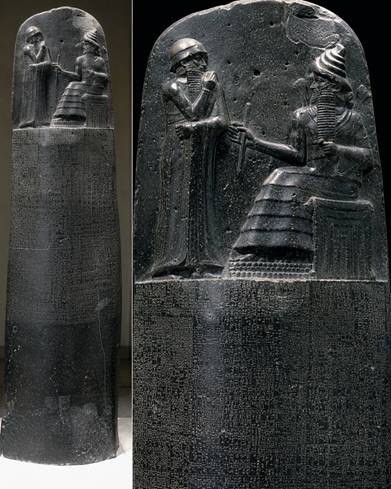
To truly understand the laws of God, one ought to compare and contrast the laws of Hammurabi with God’s laws. In many cases, God deliberately contradicted the law of Hammurabi in order to prevent injustice and to abolish unequal justice between classes of people.
The court system that Moses set up presumed that some of the judges would have imperfect knowledge of the laws of God. Hence, the people had the right to appeal to a higher court if they believed that justice had not been rendered—for any reason.
This right extended to cases where injustice remained on account of no witnesses to the crime, as we have already shown. This provision also prevented a jealous husband from punishing his wife on mere suspicion of adultery. By appealing to the priest (who acted as a judge), he mediated the case to the high court by means of an oath and left it in God’s hands for judgment.
If she were, in fact, guilty, after taking an oath of innocence, she would be judged by God for violating the Third Commandment, “You shall not take the name of the Lord your God in vain” (Exodus 20:7), as well as the Seventh Commandment, “You shall not commit adultery.”
In fact, because virtually everyone has been the victim of injustice in daily life, everyone has the right to appeal to the divine court. However, one must be cautious about making such appeals, because there is more to this process than meets the eye. Jesus said in Matthew 7:1-3,
1 Do not judge so that you will not be judged. 2 For in the way you judge, you will be judged; and by your standard of measure, it will be measured to you. 3 Why do you look at the speck that is in your brother’s eye, but do not notice the log that is in your own eye?
God’s law itself is the standard of measure for all righteousness. Such a measure is established by the law of equal weights and measures in Leviticus 19:35, 36,
35 You shall do no wrong in judgment; in measurement of weight, or capacity. 36 You shall have just balances, just weights, a just ephah, and a just hin…
When buying or selling grain by weight or by ephahs, one must use the standards set by the law. On a New Covenant level of understanding, we are to use God’s standard of measure in all matters of justice. If we fail to judge righteously, Jesus explained, God will judge us according to our own (unjust) standard of measure.
More than that, if we appeal a case to the divine court, God will judge not only the immediate case itself but also more broadly, taking into consideration how we may have judged others for similar injustices. In other words, God looks at precedents to see how we have judged others in previous cases, so that He may judge the current case by the same standard of measure.
The problem is that virtually everyone has judged others unjustly or with partiality or self-interest or even without cause. Hence, if I appeal to the divine court for justice, I must be ready to accept responsibility for the times when I have done the same to others. Most people, being unaware of God’s standard, think that God limits His judgment to the immediate case at hand. But that is not so, because to judge righteously, God must look at one’s own precedents that were set prior to the present case.
I learned this from hard personal experience many years ago. God did indeed take the case when I appealed to Him for justice, but I quickly discovered that He would judge me first by my own standard of measure. It was not that my case was frivolous, but that He would judge both sides with impartiality and begin this judgment with me.
A biblical example of this is found in Judges 19 and 20. The townspeople of Gibeah, within the borders of the tribe of Benjamin, abused and killed the concubine of a priest. He appealed the case to the other tribes, who then rose up in horror and declared war on Benjamin. These tribes inquired of the Lord incorrectly. Instead of asking, “Should we go to war?” they asked, “Who shall go up first for us to battle against the sons of Benjamin?” (Judges 19:18).
So Judah led the first battle and killed 22,000 of the men of Israel. This shocked the Israelites, for they were defeated even when they obeyed the word of the Lord. They inquired a second time, and this time they asked the right question: “Shall we again draw near for battle against the sons of my brother Benjamin?” (Judges 19:23). It was the right question, but by this time the case had already been filed, and God was executing justice upon Israel first.
God told them to continue the fight. Another 18,000 Israelites were killed. Imagine their dismay! No doubt the warriors of Benjamin thought that God had vindicated them, but that was not so. He was simply judging Israel first, because they had appealed to the divine court. For some reason, God required 40,000 Israelites to be killed--an interesting number in itself.
In the third battle, the tribe of Benjamin was nearly destroyed. We read in Judges 19:46, 47 that 25,000 were killed, and only 600 men were left out of the entire tribe. All the women and children were killed as well. Later, in order to revive the tribe itself, the Israelites decided to arrange a dance for their young daughters and allow the 600 men of Benjamin to “kidnap” them and take them as their wives.
This was how the tribe survived, and centuries later, the apostle Paul was born through the tribe of Benjamin (Romans 11:1).
It is clear from this biblical account in the book of Judges that the other tribes of Israel had been horrified at the sin of Benjamin while they themselves were liable for the same type of sins. The law of impartial judgment and the law of equal weights and measures, as interpreted through New Covenant eyes, is something that everyone must consider when appealing to the divine court.
It also raises the question about the law of jealousy in Numbers 5. If a man has committed adultery in the past, but then later accuses his wife of adultery, how would God judge his case? What about the New Covenant standard regarding adultery? Jesus said in Matthew 5:27, 28,
27 You have heard that it was said, “You shall not commit adultery;” 28 but I say to you that everyone who looks at a woman with lust for her has already committed adultery with her in his heart.
Given the high standards of righteousness under the New Covenant, reflecting the nature of God Himself, how can we judge at all? This is why Jesus’ warning in Matthew 7:2 is so serious. Yet this does not ban all judgment; it simply tells us of the impartiality of justice in God’s law. It does not mean that no one should be appointed as a judge; it simply means that judges ought to be knowledgeable of God’s laws in order to administer justice impartially.

Dr. Stephen Jones has been writing blog posts since 2005 on a variety of topics from Bible Studies to World News, and he has been writing books since 1992. Dr. Jones' most important writings came after God brought him back into the full-time ministry in 1991. It is here that all his earlier years of searching the Scriptures began to come into clear focus. He combines a knowledge of the Old and New Testaments with a personal revelation of God that began and developed during the "wilderness" period of his life, which he often refers to as God's True Bible College... Read More
We are only able to do what we do because of your support. If you feel led to support this ministry, we deeply appreciate it