Latest Posts
View the latest posts in an easy-to-read list format, with filtering options.
View the latest posts in an easy-to-read list format, with filtering options.
Multi-part posts on a particular topic, grouped together in "series" pages.
Look through our blog archive by year / month, or in a massive title list.

10/19/2026 - https://www.youtube.com/watch?v=ToksxXw0e_Q... Read More
10/19/2026 - When God told the prophet to eat the scroll (the word of God) in Ezekiel 3:1-3, its sweetness does... Read More

10/16/2026 - I received this email from Pastor Fiaz recently: Dear Dr. Stephen E. Jones, May the Lord richly bl... Read More
Read over 100 books written by Dr. Jones, available to read for free online. Several of the books have also been translated into different languages, and are also available to read for free. The only time you pay is when you purchase a physical version of a book.
View Full Book List

Read a variety of tracts that condense a topic into a short, single page format. These tracts can be read for free online, or physical copies can be purchased in bundles. If you are subscribed to the FFI Newsletter, you will receive new tracts when they are released.
View Full Tract ListThe law of God establishes the rights of God and men. The First Commandment establishes God’s right to be worshiped and obeyed, based upon His right as the Creator and Owner of all. In fact, the first four commandments primarily address God’s rights. The last six commandments set forth the God-given rights of man. These two sets of commandments are thus summarized by the two great commandments—to love God and to love your neighbor as yourself (Matthew 22:37-39).
These commandments have never been repealed, abolished, or put away, regardless of how many carnal minds try to do so. The commandments still define sin (or debt), for 1 John 3:4 says, “sin is lawlessness.” Paul agrees, telling us in Romans 7:7,
7 What shall we say then? Is the Law sin? May it never be! On the contrary, I would not have come to know sin except through the Law; for I would not have known about coveting if the Law had not said, “You shall not covet!”
Those who do not learn the law may not realize that certain things are sinful. The culture in which we live often differs from Kingdom culture, setting forth different standards of righteousness for the people. Likewise, a beast empire is one that covets the territory and resources of another country, and it feels perfectly justified in seizing whatever it covets according to the law of “might makes right.” The Kingdom of God condemns that standard. The Kingdom of God protects the rights of weaker nations, giving them equal justice and respect.
A debtor is one who owes a debt and is obligated to pay a creditor. Debts may be incurred through natural disasters, unwise investments, or by sin. One who sins against his neighbor becomes a debtor, and the creditor is the one whose rights have been violated. Sin creates a debt to God as well as to the earthly victim of injustice. The idea that sin is a debt owed to God is deeply rooted in Scripture itself.
Jesus taught this directly in the Lord's Prayer. Matthew 6:12 says,
12 And forgive us out debts, as we also have forgiven our debtors.
A parallel version in Luke 11:4 reads,
4 And forgive us our sins, for we ourselves also forgive everyone who is indebted to us…
Luke makes it clear that “debts” and “sins” were understood as equivalent concepts. To forgive sin is to forgive the debt that the sinner owes on account of his violation of a God-given right. So if a man steals another man’s sheep, he owes his victim double restitution—two sheep (Exodus 22:4). If the stolen sheep cannot be returned alive and intact, the thief owes fourfold (Exodus 22:1). If a thief steals the tools of a man’s trade (such an “ox”), he owes fivefold. This is the divine standard setting forth the level of debt for sin.
This applies also on a national level—example: Mystery Babylon. Revelation 18:6 says,
6 Pay her back even as she has paid, and give back to her double according to her deeds; in the cup which she has mixed, mix twice as much for her.
In addition, we are told that Mystery Babylon, pictured as a great harlot (Revelation 17:1), will be “burned up with fire, for the Lord God who judges her is strong” (Revelation 18:6). This great harlot is judged in this way, according to the law in Leviticus 21:9,
9 Also the daughter of any priest, if she profanes herself by harlotry, she profanes her father; she shall be burned with fire.
In other words, the great harlot is a religious system, the equivalent of a priest’s daughter. This implies, of course, that the beast system of Babylonian government has refused to comply with the verdict in the divine court. This is called “contempt of court.” Deuteronomy 17:10-12 prescribes the death penalty for those who refuse to pay restitution as an act of repentance.
Whether we apply the law to individuals or to nations as a whole, all are obligated to obey the law of God and to remain in submission to the Creator who has the right to set the standard of righteous behavior in heaven and in earth. All individuals and nations have fallen short of this standard and are therefore debtors/sinners.
There are two ways in which one can be released (freed) from debt. The first is to pay the debt, and, if one lacks sufficient resources, to work off the debt. The second is to have someone else pay the debt. The victim (who is also the creditor) always has the option to forgive the debt owed to him. If he forgives, it means, essentially, that he is willing to take the loss and pay the sinner’s debt himself.
While it is the duty of a judge to impose a righteous sentence, it is the right of any victim to forgive the debt. Conversely, a judge does not have the right to forgive sin, nor does the victim have a duty to forgive debt. Victims alone have the right to forgive sin/debt, but here is where they must exercise discernment by the leading of the Holy Spirit.
Unrepentant sinners may actually be harmed morally if they are constantly forgiven and are never held to account. To love one’s neighbor might mean holding a sinner accountable in order to give him time to learn righteousness and repent of his lawless ways. On the other hand, if a desperate man has stolen some food in order to feed his starving family, a victim might be merciful and forgive him by understanding the circumstances that caused him to sin.
Hence, the mandate to forgive one’s debtors must be subject to the second great commandment to love one’s neighbor. In some cases, love might mean holding a sinner accountable—at least, long enough for him to truly repent and change his way of life.
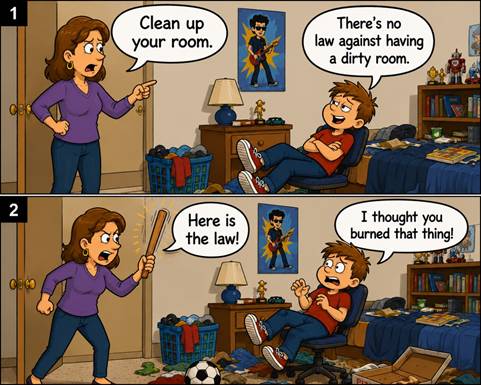
Parents do this with their children all the time. It is the nature of discipline. Discipline invariably holds children accountable for unrighteous actions—not that the parent lacks the ability to forgive, but that the child must grow into spiritual maturity so that he does not continue in sin.
God is our great Example in this, for Hebrews 12:6, 7 tells us,
6 For those whom the Lord loves He disciplines, and He scourges every son whom He receives. 7 It is for discipline that you endure; God deals with you as with sons; for what son is there whom his father does not discipline?
Have we not all experienced the discipline of the same God who loves us as His children? It is not that He lacks the ability to forgive, nor is it even that He is angry with us. It is that He is training us so that we fully come into His image. This is His definition of a “son.” Any son who remains lawless is not truly a son of God, nor will he receive a Kingdom inheritance.
Just because a believer is begotten by the Spirit and thereby becomes a son of God does not mean that he/she is instantly mature. If a man says, “I am born again,” this does not mean that he was born fully grown. No, faith is just the beginning. Faith is a Passover experience, but learning obedience through discipline is a Pentecostal way of life, preparing sons for full maturity through the feast of Tabernacles. Those “sons” who are lawless are like children who refuse to acknowledge parental authority and reject all house rules.

Dr. Stephen Jones has been writing blog posts since 2005 on a variety of topics from Bible Studies to World News, and he has been writing books since 1992. Dr. Jones' most important writings came after God brought him back into the full-time ministry in 1991. It is here that all his earlier years of searching the Scriptures began to come into clear focus. He combines a knowledge of the Old and New Testaments with a personal revelation of God that began and developed during the "wilderness" period of his life, which he often refers to as God's True Bible College... Read More
We are only able to do what we do because of your support. If you feel led to support this ministry, we deeply appreciate it