Latest Posts
View the latest posts in an easy-to-read list format, with filtering options.
View the latest posts in an easy-to-read list format, with filtering options.
Multi-part posts on a particular topic, grouped together in "series" pages.
Look through our blog archive by year / month, or in a massive title list.
10/23/2026 - Ezekiel 4:1–8 presents the coming siege of Jerusalem through a prophetic sign. Having appoin... Read More
10/22/2026 - When a watchman gives warning, he/she should keep in mind the principle in Ephesians 4:15, 15 But... Read More

10/21/2026 - I received this email from our ministry representative in Nepal today. Dear Respected Sir and pray... Read More
Read over 100 books written by Dr. Jones, available to read for free online. Several of the books have also been translated into different languages, and are also available to read for free. The only time you pay is when you purchase a physical version of a book.
View Full Book List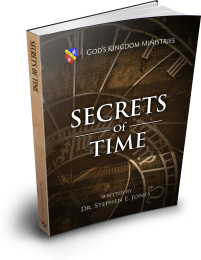
Read a variety of tracts that condense a topic into a short, single page format. These tracts can be read for free online, or physical copies can be purchased in bundles. If you are subscribed to the FFI Newsletter, you will receive new tracts when they are released.
View Full Tract List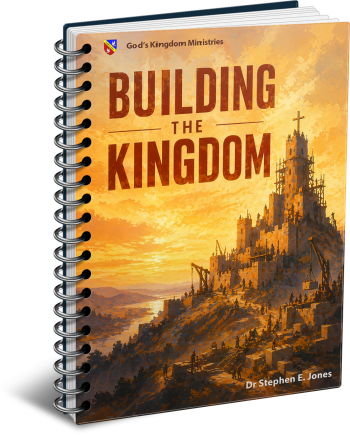
This 128-page book outlines the four main features necessary to have a Kingdom, finishing with a lengthy section on adopting a Kingdom worldview.
Category - General
The garden of Eden was the beginning of the territory of the Kingdom. Adam and Eve were banned from that territory after they sinned, as we read in Gen. 3:23, 24,
23 Therefore the Lord God sent him out from the garden of Eden to cultivate the ground from which he was taken. 24 So He drove the man out; and at the east end of the garden of Eden He stationed the cherubim and the flaming sword which turned every direction to guard the way to the tree of life.
Having lost access to Eden (with its Tree of Life), the rest of the biblical story is about finding the lawful path back to Eden. The Door is Jesus Christ through whom we must all come. The cherubim guard the entrance with a flaming sword, forbidding entry to those who are without Christ. Later, the cherubim also guarded the entrance into the Most Holy Place in the tabernacle of Moses (Exodus 26:31).
The cherubim did not prevent Moses from entering the Most Holy Place. It only prevented the unqualified from entering. The flaming sword is the word of God (Eph. 6:17), which also comes from the mouth of Christ (Rev. 1:16). It is the standard of the “fiery law” (Deut. 33:2, KJV), which is a metaphor describing His own nature.
The standard was set and the rules were put in place by which men could walk past the cherubim unscathed. The cherubim must see the image of God in those who wish to return to Eden.
Eden was a starting point for the territory of the Kingdom. Though its territory is no longer particularly relevant, we know that the divine purpose is to reclaim the entire earth and return it to its Edenic state when His glory covers the earth (Num. 14:21).
“God formed man of dust from the ground” (Gen. 2:7), dust that reflected the glory of God. Dirt is not inherently evil, as the Greeks thought. Having already pronounced the earth “very good” (Gen. 1:31), God imprinted His image into the earth itself.
The Greeks thought that the problem of imperfection had to be resolved by a great divorce, where God removed Himself from “evil” matter. But the Bible teaches that the solution is for God to cover the earth with His glory in a great marriage of heaven and earth.
The ultimate inheritance, then, is for man to have a glorified body, not for him to shed his dust and live only in a spiritual state. The meek, Jesus said, were to inherit the earth (Matt. 5:5, KJV). Each one has his own piece of the earth to inherit. Each piece is his/her own body, which, like Eden, is the beginning of the territory of the Kingdom. It is each one’s “promised land,” because until we actually come into the image of Christ, we have only God’s promise of an inheritance yet to come.
Those who have Abrahamic faith are those who actually believe that God is able to deliver on His promises (Rom. 4:21). By faith we may now claim the inheritance, even as the Israelites claimed their family estates in the land of Canaan while they were yet imperfect. Nonetheless, the promise is not complete until we are perfected and fully reflecting the image of Christ. Only then can it be said that we have inherited the Kingdom.
The promise that God gave to Abraham was that he would be given “the land which I will show you” (Gen. 12:1). By not specifically mentioning any particular land, God left the meaning obscure. We know that Abraham was led to the land of Canaan, so most people assume that this was his final inheritance. But Heb. 11:8-10 says,
8 By faith Abraham, when he was called, obeyed by going out to a place which he was to receive for an inheritance; and he went out, not knowing where he was going. 9 By faith he lived as an alien in the land of promise, as in a foreign land, dwelling in tents with Isaac and Jacob, fellow heirs of the same promise; 10 for he was looking for the city which has foundations, whose architect and builder is God.
First, Abraham “went out, not knowing where he was going,” because the promise was obscure. Secondly, “he lived as an alien in the land of the promise, as in a foreign land.” Third, he was “dwelling in tents,” a temporary dwelling, because “he was looking for the city which has foundations.” Tents do not have foundations, for they are not permanent dwellings.
We read further in Heb. 11:13-16,
13 All these died in faith, without receiving the promises, but having seen them and having welcomed them from a distance and having confessed that they were strangers and exiles on the earth. 14 For those who say such things make it clear that they are seeking a country of their own. 15 And indeed, if they had been thinking of that country [Canaan] from which they went out [when taken to Assyria as captives], they would have had opportunity to return. 16 But as it is, they desire a better country, that is, a heavenly one. Therefore, God is not ashamed to be called their God; for He has prepared a city for them.
The author’s point is that the land of Canaan itself was only a temporary “tent” for the heirs of the promise. If that land had indeed been their ultimate land inheritance, “they would have had opportunity to return.” But they were NOT to return, because, like Abraham, “they desire a better country, that is, a heavenly one.”
In other words, Canaan, which was called “the promised land,” was not the ultimate promised land. It was a temporary place until such time as the real promised land could be obtained—the “better country.” This is obviously not the old land of Canaan but something “better.” The book of Hebrews is all about the changes that took place from the Old Covenant era to the New Covenant era. It is not that the first era was “bad,” but that it was a type and shadow of better things to come. The heavenly country and city (New Jerusalem) are among those “better” things.
Zionists today seek to regain the land where Abraham lived, but not the land that Abraham actually sought. They have no vision of better things, because Zionism is not based on the New Covenant. Therefore, Zionists seek fleshly things that have limited value—most of which are now as “obsolete” as the Old Covenant (Heb. 8:13).
Nonetheless, the Old Covenant fulfillment of the promise of God provides us with patterns by which we may understand the true and permanent inheritance that Abraham sought. We have our own Joshua (Yeshua) who is leading us into the true promised land by faith, just as we have our own “Moses” who led us out of the house of bondage when He died on the cross on Passover and was raised the third day.
The Passover Age (from Moses to Christ) was the first step of three. That first step brought the Israelites into Canaan, their “promised land.” But immigration to that land did nothing to change the hearts of the people. Crossing the Jordan River only changed the geographical location of their dwellings.
Previously, when they were called to enter the promised land on the 50th Jubilee from Adam, they lacked sufficient faith (Num. 14:1, 4). Theoretically, if they had possessed a Tabernacles-level faith, they might have entered the land with glorified bodies, thus truly inheriting the promise of God. But as it stood, they had to wait 40 years, and even then, they entered the land at the time of Passover, not Tabernacles (Joshua 4:19; 5:10).
It was too soon for them to fulfill the last great feast, for they lived in the time of types and shadows, and the true Joshua had not yet come to die and to clear the way into the Most Holy Place.
This is not to say that flesh has no place in the plan of God. While “flesh and blood cannot inherit the kingdom of God” (1 Cor. 15:50), Spirit-filled flesh is our inheritance. We are now the temple of God (1 Cor. 3:16), wherein the presence of God now dwells. We are the so-called “third temple—not a rebuilt temple of wood and stone in Jerusalem. Paul makes this clear in Eph. 2:20-22,
20 having been built upon the foundation of the apostles and prophets, Christ Jesus Himself being the corner stone, 21 in whom the whole building, being fitted together, is growing into a holy temple in the Lord, 22 in whom you also are being built together into a dwelling of God in the Spirit.
This inheritance is for those who walk “the Highway of Holiness” (Isaiah 35:8), which is the path, figuratively speaking, through the outer court, through the Holy Place, and into the Most Holy Place. It is the path of Passover, Pentecost, and Tabernacles. To enter this promised land, one must be justified, sanctified, and glorified. Nothing short of this meets the requirement of God that will satisfy the cherubim in allowing anyone to regain access to Eden.
We are only able to do what we do because of your support. If you feel led to support this ministry, we deeply appreciate it